Porta-Fi: Shoddy Goods 092
1
There’s a spectrum of music lovers that runs from those who value fidelity above all else to those who value convenience. I’m Jason Toon and I’m toward the convenience end, but even I draw the line at listening on a phone’s built-in speaker. Anyway, this Shoddy Goods, the newsletter from Meh about consumer culture, is about when General Electric tried to appeal to both ends of the spectrum and wound up satisfying neither.
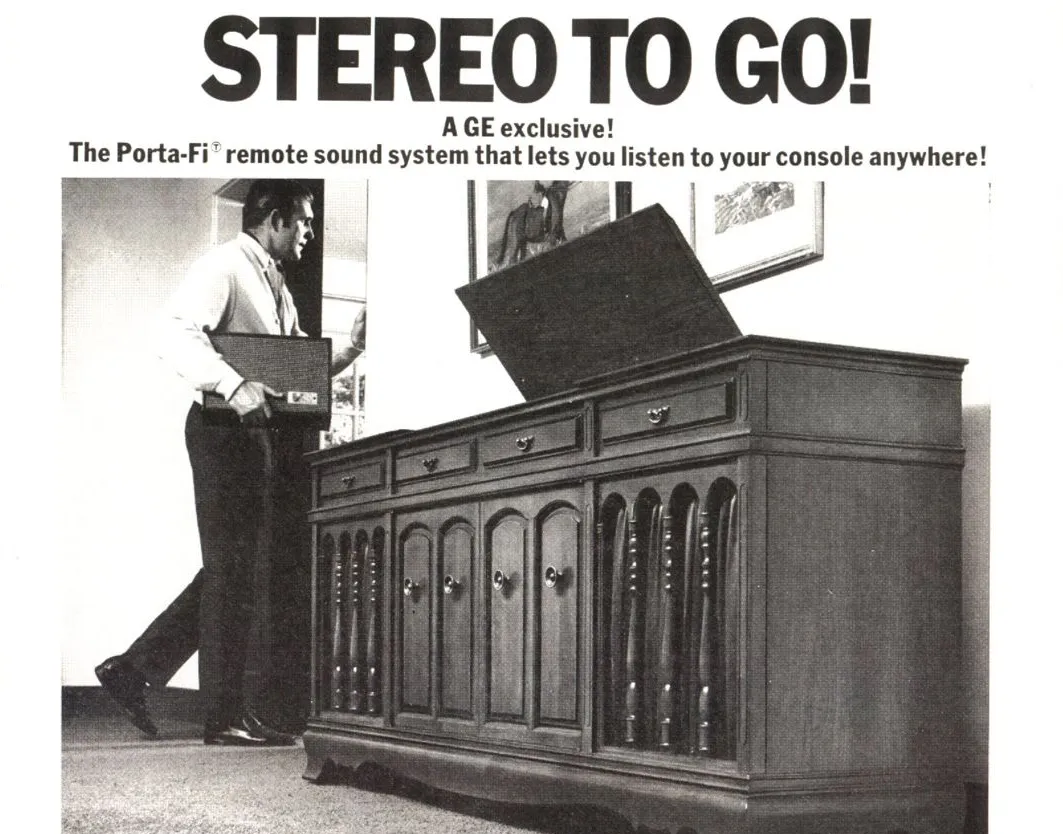
I mean, any stereo is “porta” if you turn it up loud enough
“It’s like having any room in your house wired for sound - *without *one extra wire.” That was General Electric’s pitch in the 1965 ad campaign for their new Porta-Fi system. One big console was the source of the records or radio, while a shoebox-sized portable speaker brought the audio to anywhere in the house with an AC outlet.
As American homes got bigger, along with spending on home entertainment, GE bet on Porta-Fi to vault their audio division ahead of competitors like Magnavox, RCA, and Zenith. So why aren’t we all grooving to the Porta-Fi beat today? Because of other trends that GE didn’t predict, which ultimately did more to shape how we listen to music.
Plug in, turn on, buzz off
For almost as long as homes have been wired for electricity, people have been trying to use those wires to carry other kinds of signals. The science for multi-channel power-line telephony was demonstrated in 1910. Dozens of shared power/telephone systems were in operation in the 1920s, especially in Europe, before being overtaken by generally superior separate lines for each. Electrical companies have long talked to technicians through the power lines they’re working on, and used power-line communication for automatic meter reading.
In the home, the first baby monitor sent radio signals through a home’s electrical wiring as long ago as 1937: that’d be the Radio Nurse, which will be familiar to diligent Shoddy Goods readers. The 1950s saw home intercom systems like NuTone become de rigeur in upscale new homes, again using AC lines to transmit sound.
So when GE developed Porta-Fi in the early ‘60s, the technology was tried and tested. A line of Porta-Fi-ready consoles - “The Sutton in contemporary styling, the Jamestown in Early American, and El Camino in continental design” - came with their own transmitter and remote speaker. Plug the transmitter in with the console, plug the portable speaker in somewhere else, and a low-frequency FM signal travels along the power lines from the former to the latter. Simple, indeed: “as easy as plugging in and turning on a lamp”, as one ad put it.
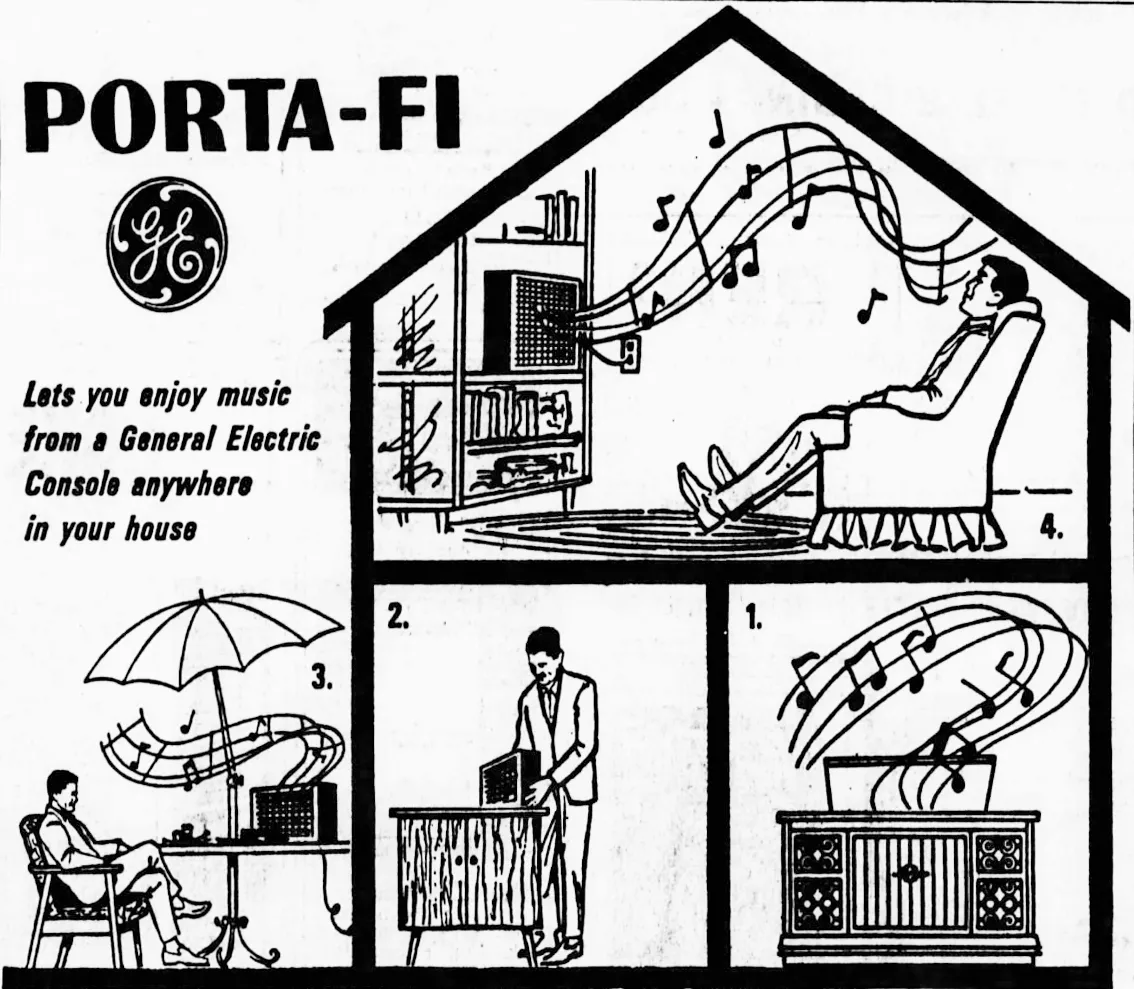
Just chilling with some patio jams while wearing a suit
Unfortunately, the further away the speaker was from the console, the worse it sounded. As a 2012 demonstration shows, the cumulative interference on the line produces an increasingly loud buzz as the path gets longer. Just because power lines can carry sound doesn’t mean they’re good at it. They’re just not made to shield the audio signal from everything else.
At one point, midcentury listeners might have been willing to put up with that noise for the convenience and sense of futuristic freedom. By 1965, that point was fast fading into the past.
Bye bye, Miss GE Porta-Fi
At the higher end of home audio, the late ‘60s and early ‘70s saw huge leaps and bounds toward ever-higher fidelity, now considered a Golden Age for hi-fi sound. GE would have loved to attract these free-spending audiophiles, but that buzz would’ve been an immediate buzzkill.
Down at the lower end, portability wasn’t the draw it used to be. Cheap transistor radios took off in 1957 and 1958, no AC outlet required. The first boomboxes were on the horizon, appearing in Europe and Japan in the late 1960s. There wasn’t much novelty left in listening to music in any room of the house - certainly not enough to invest in a massive new GE console.
Speaking of which, stereo consoles themselves were reaching their run-out groove. Newer audio gear was both more compact and higher quality. The aforementioned audiophiles preferred the customizability of component systems, and the stereo’s place as the center of family entertainment was more and more lost to the TV. If Americans were going to devote space to a big, bulky piece of technological furniture, they preferred to be able to watch it.
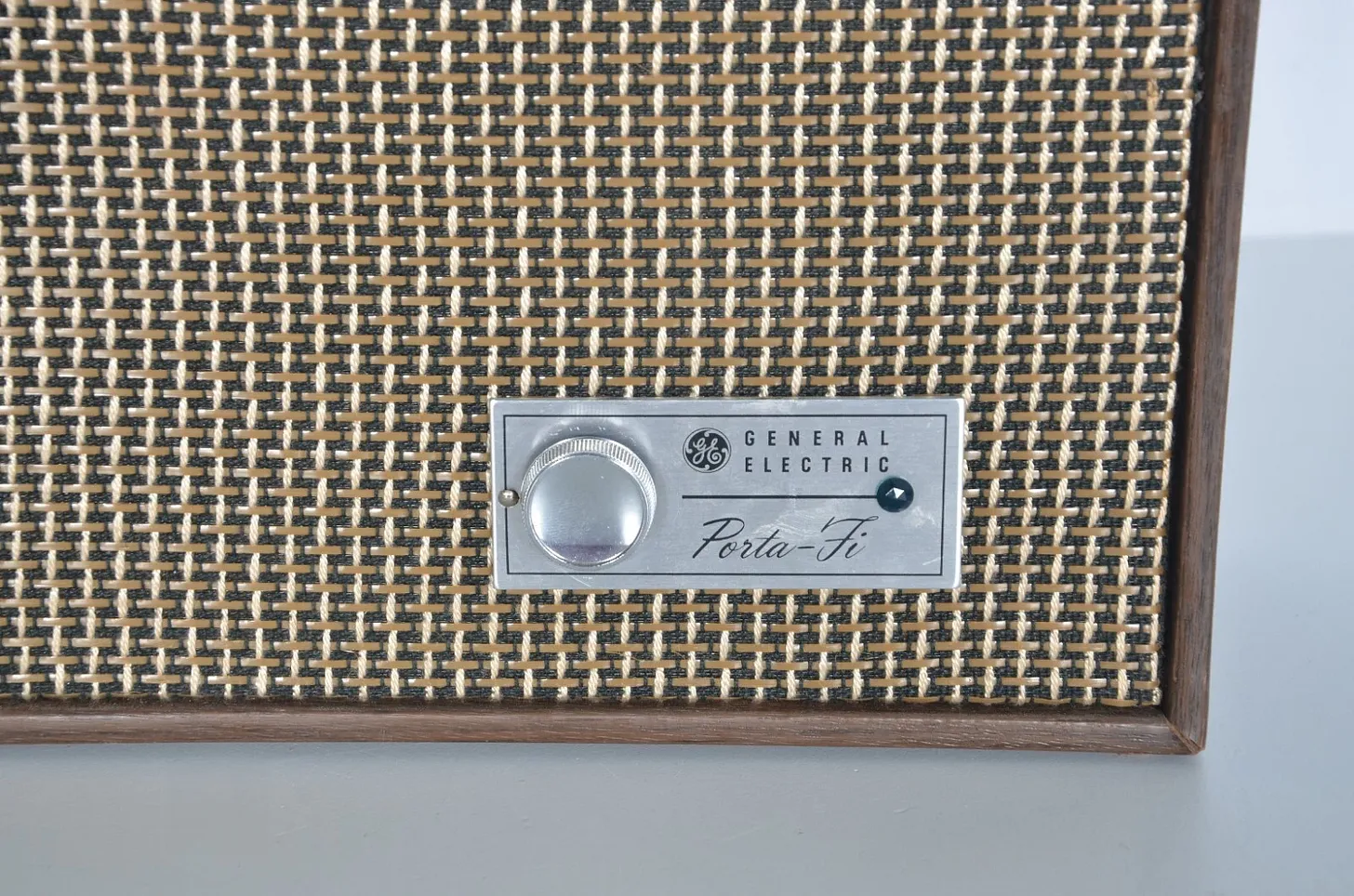
It looks better than it sounds
By the early 1970s, GE had phased out Porta-Fi and its whole line of consoles with it. It didn’t turn out to be the savior of their stereo business, much less the wave of the future. Maybe if they’d had the idea a decade earlier, Porta-Fi might have caught on. Or maybe it just wasn’t quite either “porta” or “fi” enough to have a reason to exist.
In an echo of Porta-Fi’s problems, the idea of using power lines for Internet data would founder decades later on similar issues. In the early days of online infrastructure, broadband over power lines (BPL) seemed to hold some promise. Why bother building out extensive broadband networks when we already have this grid of wires that go to every house?
But it was another case of the wrong tool for the job. Again, all that noise on the line was too much to overcome, and increasing wireless coverage put paid to the idea for good. The various BPL projects were wound down by about 2010, never to be revisited. It was an ending that any Porta-Fi owner could’ve heard coming.
Where are you at on the audiophile spectrum? I bought some reasonably high quality but still fairly small speakers for my TV set-up…in 1999. Still using those! And I basically gave up on all headphones and even most other speakers once I got my Airpods. Do you go all in on sound quality, or are you more about cheap and convenient? Let’s hear about your sound set-up and audio gadgets in this week’s Shoddy Goods chat.
—Dave (and the rest of Meh)
Enjoy these previous Shoddy Goods stories in any room of the house, without extra wires:
- 11 comments, 6 replies
- Comment
Depends.
At home, I
havehad a personal 7.1 channel set-up within a pod of tables (work desk, rolling chair, two stands to the sides). My television had 5.1 surround sound. I had those obviously large headsets.Then things change, furniture gets rearranged, wires have to be pulled back, padding erodes, soundproofing gets expensive, and I’m stuck with whatever’s cheap and on-hand.
I was really into surround-sound setups like 20 years ago. With the advent of modern soundbars + remote subwoofer, I can get all the sound quality I really need now. I do like my airpods as well.
This email amused me to no end. I have a Porta-fi console and a few speakers. I have only actually tested the speakers on the same power strip I had the console plugged in to though. I can’t imagine with all the LEDs and switch mode power supplies in a modern home it would work well at all a Ross a home like it was intended, but it sounded quite good all plugged into the same power strip!
@batlis Do you want a Channel B SP 41 BWD Porta fi speaker? I got it at a local auction for cheap not knowing what it was. If you are in the DFW area, I’ll give it to you.
@bluebeatpete thank you, but I’m up near the Chicago area.
Are you literally asking the Meh user base “are you more about cheap and convenient?” ???
Did you forget who you were talking to?
Really good sounding equipment can give me the chills with the right music, and I’ve accumulated a couple of pieces that can do that. But convenient speakers, headphones, and what not are, well, convenient. And I’ve accumulated a few more of those. And then probably most frequently I listen to music on an echo dot because it’s nearby and I can just tell it what to play and it (mostly) does.
I mean for a newsletter about shoddy goods, talking about failed powerline communication products, X10’s powerline home networking protocol was right there…
I kept a transmitter and remote wireless speaker system running for years (Acoustic Research AW-871s) . Finally decided to reclaim the real estate (and power outlets) for each of those half dozen speakers that were scattered around the house. Plus the transmitter was across the house in the den (connected to a dedicated tablet that I could run my Pandora or Amazon music accounts from). Now I use a cell phone and rechargeable Bluetooth speaker that I can hear through most of the house.
If I’m working outside I’ll use either BT (cheap) earbuds or my old Sansa clip and wired headphones since both those fit underneath the hearing protectors when I’m on the mower, using the trimmer, etc… In the shop I will frequently use the old Banana Boat floating orb that I got here years ago…
When traveling I tend towards BT headphones since I wear hearing aids (but not as often as my wife would like me to )
)
@chienfou WHAT?!?!
@bee1doll
Hunh?..Quit mumbling!!
Who, me? I don’t understand the whole mp3 vs flac argument. They sound the same to me. So, I’m probably in the convenience side of this discussion. (and trying to add a dot before the mp3 is maddening. The editor wants to terminate the sentence and capitalize the M in mp3. So,. Mp3 looks like this.)
@boothbyd for particularly loud songs, an MP3 may hit white noise at certain parts. Similar to a scratchy record or a re-recorded cassette.
I still use my old 130 wpc receiver, Thorens TT, speakers from the 70’s I rebuilt, hundreds of extremely clean albums, some I’ve had since 1970. I listen to them almost daily. Nothing wireless, but then I’m an old geezer.
@daveinwarsh
One of my biggest disappointments was losing hundreds of albums in a flood in my shop. I had stored thee during a remodeling project. Totally broke my heart to lose all those but once they got wet they were pretty much trashed. All the covers got soaked and ruined. In retrospect I should have put them up on something… lesson learned.
Back in my callow youth in the late 60s and early 70s II sold audio equipment in a store that had it all from cheap all-in-one desktop record player/radio/8-track players to high end component systems. One of the bits of advise given to me by one of the company reps is that there are customers who are only interested in listening TO the music, while at the other end of the spectrum are the customers who want to listen AT the music. Listening TO the music is going about whatever you are doing with music in the background. Listening AT the music is devoting your whole attention to the music performance being recreated. But even devoted audiophiles do both at one time or another.
While I like assembling a stereo system, or recently a 5.2 surround system, the reality is that moving to Sonos 20 years ago was a huge game changer. Put the speaker where you want, plug it in and it works. Now that you don’t need your own library of music or any knowledge of networking it’s even easier. The irony is how much I jawboned my Dad that he needed to move to stereo and now so much of my music comes from that one speaker in the corner - although mine is Sonos and his was Heathkit…