Little lost lamb: Shoddy Goods 079
5
Time for another Shoddy Goods, the newsletter from Meh about consumer culture, with me, Jason Toon. I was a vegetarian for 20 years, so I understand that those of you with misgivings about meat may want to pass on this very carnivorous issue…
As I’ve written before, Australian life isn’t drastically different from life in the USA… until it is. Like when you have to slow down because the road is covered in cockatoos, or you’re surprised by what everyone does after they sing “Happy Birthday”, or lamb is on the menu for dinner. And lunch. And sometimes breakfast.
Australia and New Zealand are famously sheep-happy nations, so I shouldn’t have been surprised. But I’d never had lamb in my life, or even been anywhere it was being served. It seemed like something people used to eat: I could imagine June Cleaver buying a leg of lamb at the grocery store more easily than I could imagine my mom serving one up.
How did two countries with such similar cultural roots and current lifestyles reach such different conclusions about one of humanity’s basic meats?
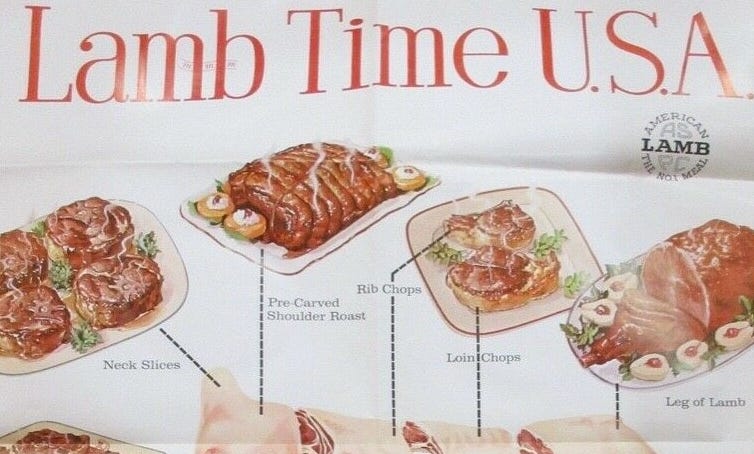
Any minute now…
Blip blip black sheep
Turns out it’s not just me: by global standards, Americans eat hardly any lamb (and its grown-up version, mutton), and Aussies eat heaps of it. The OECD average for per-capita sheep meat consumption in 2024 was 2.4 pounds a year. In Australia, it’s 16.3 pounds, while in the USA, it’s 0.88 pounds. Compared to the 100 pounds of chicken, 60 pounds of beef, and 50 pounds of pork the average American eats annually, lamb is a blip.
If anything, that 0.88-pound average overstates lamb’s popularity in America, because consumption tends to be concentrated in immigrant communities from sheep-eating countries. One study found that 50% of Americans have never tried lamb even once, and most of those who eat it only do so once a year, at Easter. “The Northeast, with its high concentrations of Middle Eastern, Caribbean, and African consumers, is a major market for lamb products,” says the US Department of Agriculture. “The typical lamb consumer is an older, relatively well-established ethnic individual who lives in a metropolitan area.”
My sense that lamb used to be more popular in the United States is also borne out by the numbers. In 1960, the average American ate 5 pounds of lamb a year. It’s never been one of the most popular meats in America: a 1924 Better Homes & Gardens article observed that “few housewives are acquainted with [lamb] cuts other than the leg and ribs. There is no well-founded reason for this unpopularity.” But lamb was in the mix far beyond where it is today.
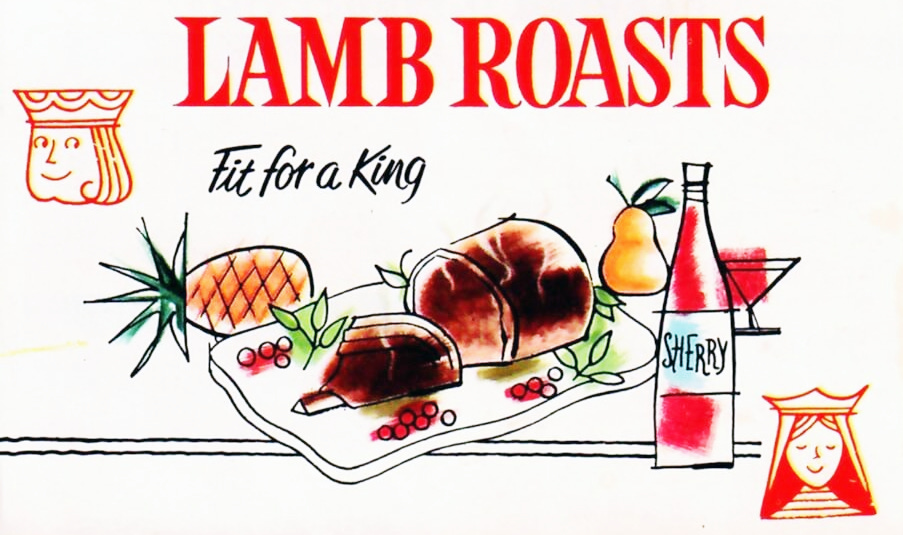
And we know how Americans feel about kings
Not a matter of taste
The various theories for how this came to be range from the inherent and personal - Americans just don’t like the taste, lambs are too cute to eat, etc. - to the external and macroeconomic, citing climates, lifestyle patterns, and the livestock industry.
The subjective ones are easier to shrug off. It’s true that lamb has a strong, distinctive taste. Trying to describe flavors is like trying to paint grammar: the oft-cited “gamey” isn’t exactly right. “Earthier” is closer but still not it, exactly. Lamb has a, let’s say, robust flavor that takes some getting used to if you didn’t grow up with it. But there’s no reason to think that Americans and Australians (or Greeks, or Turks, etc.) are so biologically different that one can love lamb and the other can only hate it. There is no known “cilantro gene” for lamb.
One variant of that theory says that American soldiers in either World War I or World War II were subjected to so much low-grade canned mutton that they rebelled against the idea of eating sheep ever again. But this extensive Wikipedia article on US military rations only mentions one “experimental” mutton ration that was quickly discontinued. The other rations cited as widely loathed, like beef hash and ham with lima beans, didn’t hurt those meats’ popularity.
As for lambs being cute, I tend to think that first we decide which animals are for eating, then which animals are for cuddling. Cows and pigs can be pretty darn cute, too, and we eat plenty of those. But I’ll allow that the fact that meat lambs are killed when they’re under a year old probably hasn’t helped, in the same way that US veal consumption has all but collapsed. Then again, that doesn’t explain Americans’ disinterest in mutton, made from adult sheep.
All in all, I’m skeptical of subjective, “it’s a matter of taste” explanations for large-scale consumption anomalies like the absence of sheep from the American table.
Cow vs. sheep
One reason often cited for the difference between the US and Australia is that the latter’s climate and land is just more suited for raising sheep. Again, it doesn’t quite hold up: both countries have vast swathes of the semi-arid grassland where sheep thrive. That’s why there were some 45 million sheep in the US in 1867, rising to a peak of 56.2 million in 1942, before declining to something like 5 million today.
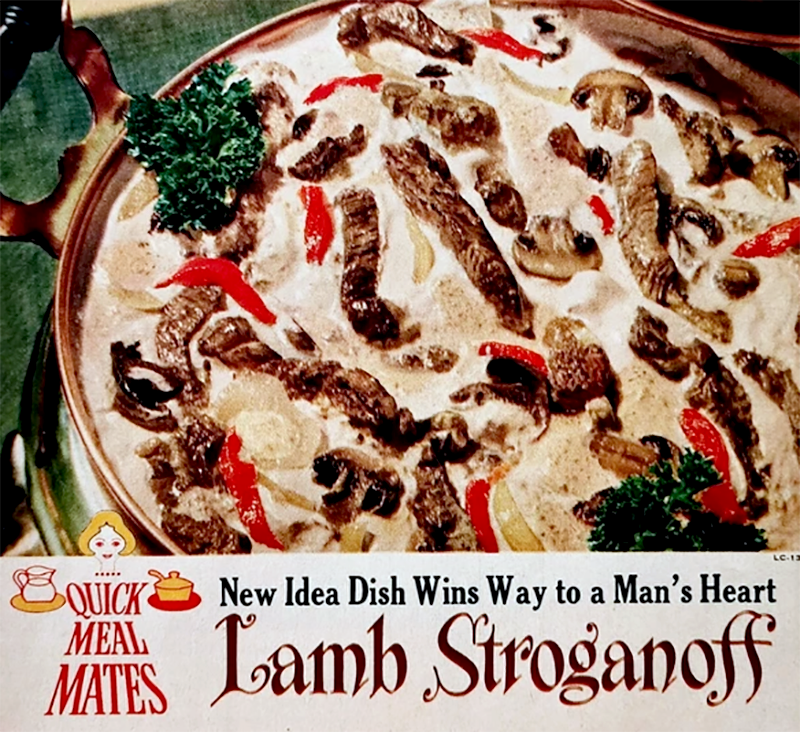
Food photography has come a long way
But meat wasn’t behind the raising of all those sheep. The wool was the main attraction. For a long time, the sheep meat industry in the US was a sideshow to the much bigger wool industry. Every spring, herders culled unneeded young male sheep by sending them to slaughterhouses, but the real money was in wool - until synthetic fibers came along after World War II. Wool prices collapsed, and thus so did the profitability of sheep.
That was enough to tip the economics of pasture animals decisively toward cows. “There were cattle producers and sheep producers side by side in most areas,” economic historian P.J. Hill, who grew up on a sheep ranch in Montana, said in 1993. “Very seldom was it the rule that either cattle or sheep dominated. But it doesn’t take tremendous shifts in either input or output prices to shift production from one to the other.”
Of course, nothing succeeds like success. Once the beef industry started to get the upper hand on its pastoral rival, it parlayed that strength into further advantages, from friendlier federal grazing regulations to promoting beef as a quintessential part of American culture.
Pasture prime
Sad to say, the loyalty of some ethnic communities to lamb didn’t help its acceptance in the wider US market. “Sheep also came to be seen as a meat for immigrants, particularly those from southern and eastern Europe, who were America’s most reliable lamb eaters,” writes economic history professor Iker Saitua. “American Indian tribes, particularly in Navajo country, also embraced lamb. These social and ethnic associations with sheep meat cemented its outsider status. Meanwhile, the meatpacking industry promoted beef as quintessentially American.”
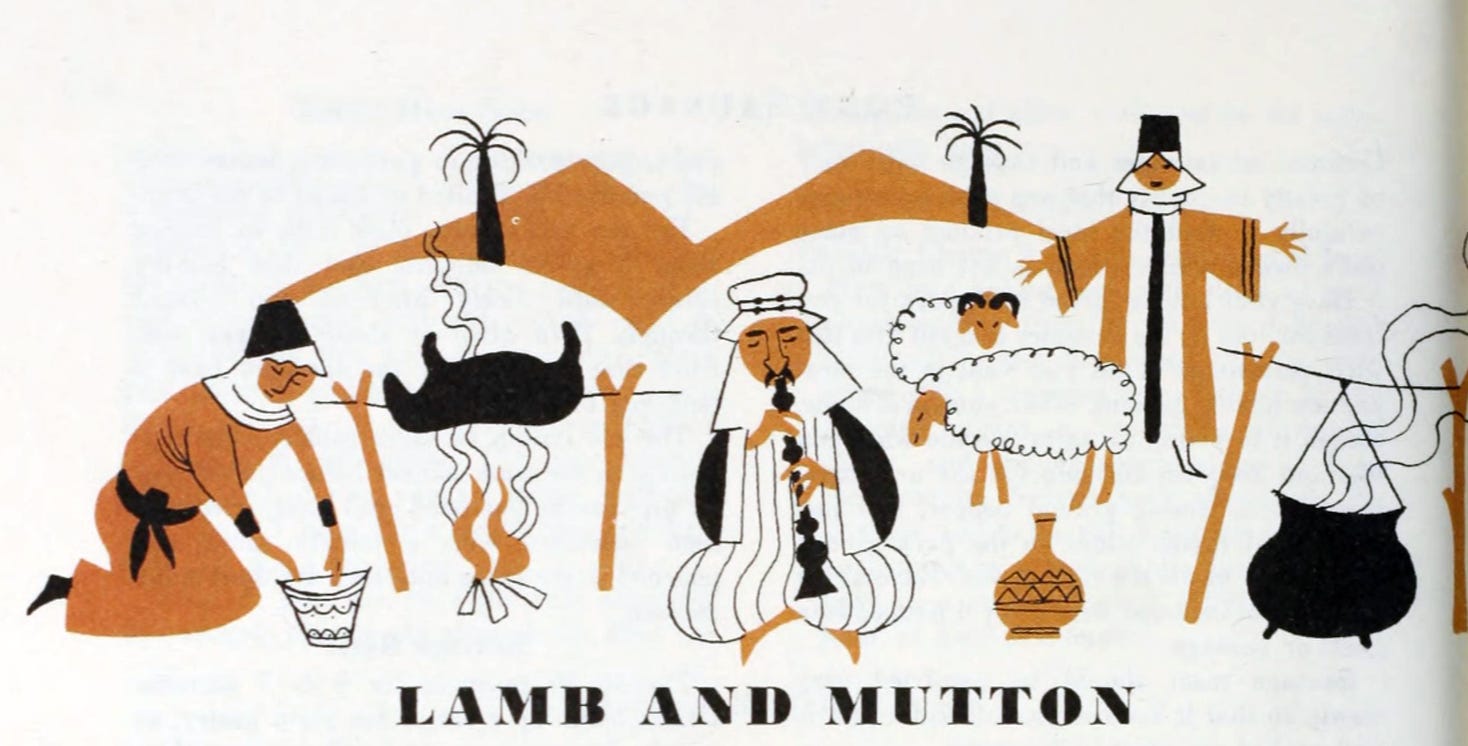
The midcentury American view of sheep meat, from a 1949 James Beard cookbook illustrated by Alice and Martin Provensen
Sheep meat started a downward spiral where low supply meant higher prices, which lowered demand, which led to even lower supply, and so on. In the postwar years, the USA was a net exporter of sheep meat. Now over half of lamb consumed in America is imported from Australia and New Zealand, which only adds to the price.
If you’re an immigrant and a food is essential to your culture, you’ll pay whatever it costs. I don’t want to tell you what I’ve paid for an imported can of Libby’s pumpkin around Thanksgiving. But high lamb prices mean it’s likely to remain a specialized taste. Who wants to gamble a premium price on a weird meat you’ve never had before, possibly shipped from around the world, when you could just buy reliably delicious steak raised in the next county?
So despite the wishful optimism of the American Lamb Board, lamb is probably long past the point of no return in America. Its economically driven decline has hardened into “a social sense of rejection toward sheep meat,” as Saitua puts it, that just doesn’t exist in Australia. Chalk it up to one more little difference between my two countries… anybody want to trade some lamb for a can of pumpkin?
I just passed my 35th year of being vegetarian, but I do think I ate lamb once or twice…around Easter, maybe? It is weird it’s just disappeared. I’ve always wondered what happened to people eating a goose for the holidays as well.
How about you, ever had lamb? Alligator? Octopus? Frog’s legs? Or if you’re vegetarian, any unusual vegetables? Let’s talk weird food in this week’s Shoddy Good chat.
—Dave (and the rest of Meh)
These past Shoddy Goods stories are a low-fat, zero-cholesterol, cage-free alternative to eating food:
- From Mandela to Nixon, how the Dictabelt captured the sound of history
- The peculiarly Australian phenomenon of the showbag
- 3D-printed food is normal, actually
I just passed my 35th year of being vegetarian, but I do think I ate lamb once or twice…around Easter, maybe? It is weird it’s just disappeared. I’ve always wondered what happened to people eating a goose for the holidays as well.
How about you, ever had lamb? Alligator? Octopus? Frog’s legs? Or if you’re vegetarian, any unusual vegetables?
- 25 comments, 22 replies
- Comment
I ate a moth once.
I ate BBQ alligator in a Cajun restaurant in Dallas TX once (really just for the novelty). Kind of tough and stringy - would not order again.
Lamb many times. Octopus (sushi) a few times (not my favorite - too chewy).
@macromeh Many restaurants in my area (Central Coast California) cook octopous on a “plancha” essentially a flat grill, like fajitas. It comes out firm and steak-like, freaking love it!
@macromeh Interesting. I had alligator at a Cajun restaurant and it was like a sausage type taste/consistency. I liked it.
@macromeh I had octopus in Nice one time and it was crisp and delicious - I asked the chef the secret, and he said it was to freeze it beforehand. I’ve had restaurant octopus since that had the same texture, so maybe it’s not such a secret?
We always had lamb for Easter (with mint jelly) but not since Mom died. Lamb chops are around $17 a pound around here…
@aetris @macromeh
Sam’s/Costco and Aldi are my go to sources.
@jsh139 Not surprising - when made into sausage, all sorts of offal things taste pretty good.
I couldn’t be a vegetarian if I wanted to be. I like me too much. I’ve worked with a lot of vegetarian and vegan people but it’s not for me but I have had goose, duck, bear, Lamb Of course, rabbit. Goat. I have never had alligator octopus or snake. And I know something else that I can even remember seeing it cooking but I don’t remember what it was. SCA for some of those. Kind of fascinating
We had lamb on the regular growing up. I guess it was one of dad’s favorites. Served with mint jelly. I don’t think I’ve had it since I moved out.
Living here in Oklahoma, bison is popular, I like me a good bison burger.
We also had a Christmas goose sometimes. We also had duck and the occasional rabbit.
I don’t know if I could be a good vegan. I think eating those fake meat products is like drinking near beer. What’s the point?
But I try to incorporate more vegetables and grains into my diet.
I’ve never had breakfast octopus.
Lamb meat being a waste product makes a lot of sense. As wool became less popular, there’s less lamb meat and people buying just any meat are going to get what’s available.
I probably eat more lamb in a year than I eat any kind of beef, and that’s largely because I basically eat no beef. Turkey, chicken, pork almost entirely. I get lamb gyros now and again. I can’t remember the last time I had a regular hamburger (always paying extra for turkey) and it’s been at least a decade since I’ve had steak as a meal. Probably longer. I’ve never made it myself, never ordered it at restaurants, and only ever had it way overcooked and served to me as a child.
All my beef consumption in the past decade has largely been someone giving me a piece of steak at a restaurant to try and convince me to eat steak. And I just don’t even care for the taste.
Maybe cow will end up the same way as sheep some day when we’re all eating mystery meat grown at DuPont.
How about doing a similar article on Goat meat.
@user70118593 This is actually what I was thinking. I’ve heard (not validated/researched) that goat is the most commonly consumed meat globally. And I live in a very diverse community where I see it on menus at true ethnic restaurants which makes me wonder how many pounds ‘on average’ ‘Americans’ eat this one. I only had it once. Too chewy. And the flavor is not one I took to.
My children and I love lamb. The lamb chops from Costco are amazing.
@koojay @user70118593
If you have an Aldi close by, they frequently sell boneless leg of lamb, it is seasoned or unseasoned and a reasonable price. It’s really good sous vide then thrown on the grill.
I’ve been meat-free since ’93, so there’s a ton of stuff I’ve never had and lamb is one of them. I do remember trying rabbit once when I was a kid and my uncle shot one and my grandma cooked it. I didn’t really care for it as I recall.
Probably the most unusual vegetable I can remember eating is fiddleheads.
I’ve also eaten a quite a few different restaurants that feature food from different parts of the world; I’ll leave it as an exercise for the reader to decide which is most unusual:
Afghani
Serbian
Armenian
Persian
Greek
Ethiopian
Vietnamese
Thai
Chinese
Japanese
Korean
Peruvian
Costa Rican
Mexican
Brazilian
Indian
Nepalese
Italian
Spanish
Irish
I was confronted with lamb tartare at a wedding buffet but since I was about 7 months pregnant is was not time to try new things. More recently I’ve had ‘lamb pops’ (a single lamb rib chop) that were so delicious but probably $7 for a single bite of meat. We had lamb leftovers from a Greek restaurant (not my entree) but they did not microwave well later. My guilty craving is veal bologna. It’s so silky smooth. But I think it’s a crime to raise baby cows in crates so I buy 4oz every 5 years or so. I have to go to a family-owned Italian butcher to find it.
Pretty sure I’ve tried most of the meats. I come from a line of meat cutters (butchers) so nothing was really “off limits”. In my late 20s-early 30s, I worked as a bartender/cook at a small town bar that the first Saturday of every month we’d have a “Wild Game Feed”. I’d get a delivery of stuff from a distributor that we never knew what was coming. It never was the exact same thing twice, but it was always my job to create a feast based on whatever we received. Deer, moose, elk, geese, & pheasants were all common to the boxes we’d receive. Oddities were anything from ostrich legs (surprisingly good BTW!) to coyote (not my favorite), prairie dogs, etc.
That said, the last couple years I’ve turned to what I call “vegetarian adjacent”…eating meat maybe once or twice per week. Good for weight loss & way better for my blood-work more than anything.
@tohar1
Maybe cuz it’s around Christmas time but this was the first thing that popped into my mind when I saw that line!
I’m honestly a little surprised by the low number, just because of gyros being a pretty popular urban food. But I’ve rarely gone out of my way to get any kind of lamb and I had an ex for whom the smell triggered her gag reflex.
As for the various terrestrial meats I’ve tried, definitely alligator, rabbit, snail, emu… I think snake… I would try more oddities if they were presented to me properly deep fried.
@KlarkKent13 snails are the epitome of a butter delivery system. And I’m here for it!
So… what do Australians do after singing Happy Birthday?
@Exist
/showme “Aussie Aussie Aussie, Oi Oi Oi”
@therealjrn Here’s the image you requested for “Aussie Aussie Aussie, Oi Oi Oi”
Frog legs were popular at my house when I was a kid. Especially during family fish frys because my mom didn’t eat fish but she liked frog legs, and my dad hunted them along with the fish that was either caught by him or my uncles. Squirrel and venison were also popular at home too since my grandfather and cousins hunted.
I didn’t get a taste for lamb until I was adult as it wasn’t prepared at home. Love Gyros and grilled lamb chops. Also love calamari, especially if they include tentacles but not all do. I tried escargot once and can take it or leave it. I think it’s merely a vehicle for garlic and butter.
I’ve had alligator… It’s kinda chewy. I had the opportunity to taste rattlesnake but I passed.
Grilled eel is my absolute favorite sushi but I prefer sashimi over sushi, too much rice otherwise.
Yep, same reaction here.
@ironcheftoni @therealjrn Agreed - they could substitute erasers for the snails IMO because it’s definitely all about that sauce.
Owensboro, KY is the (self-proclaimed) BBQ Capital of the World. Their specialty? BBQ Mutton. It’s actually quite good.
@dewaynelawson I’ve had lamb Korean BBQ. They season it with cumin which i didn’t it would be good but surprisingly tasty
I just had a really interesting thought because of what Iron Chef Tony said. We say the different species per se when we talk about pigs and beef and chicken or turkey or duck or whatever that we eat. With a few exceptions we say we eat fish. Especially Whitefish we don’t usually distinguish whether it’s Cod whether it’s Pollock sometimes even whether it’s bass or trout although we might distinguish fresh or saltwater. I didn’t list how many different types of fish and seafood I’ve tried. Otherwise can’t bring myself to eat octopus or sweat because that was sort of a semi traumatic experience
@Cerridwyn in east Texas, the fish was either catfish, bream, perch or crappie. Sometimes buffalo. For some reason never bass even though I know uncle did a lot of bass fishing.
What about offal? I eat (and enjoy) beef liver, heart and tongue. Also chicken livers. Never tried (or wanted to try) brains, kidneys, tripe, sweetbreads, gizzards, etc.
And haggis is right out.
No thank you, it’s right there in the name! Blech
I sometimes see ground lamb on clearance at the grocery store (probably due to the low demand) and when I do I buy it to make authentic Shepherd’s Pie. It’s technically “Cottage Pie” when made with ground beef. The strong flavor works well with the potatoes and veg. I wouldn’t go out of my way to buy it full price though.
@cainsley We have one grocery store that offers what they call “Meatloaf Mix” which was a mix of ground beef/pork/lamb. When I lived on that side of town, I’d buy it frequently. I used it it in meatloaf of course, but also in things like Shepherd’s Pie & Tator-tot Hotdish. It was pretty dang good but I wouldn’t drive 10 miles, one way, to get more is all.
I’d never had lamb until I started dating the girl who became my wife. Her dad (French Canadian descent) made a fantastic leg of lamb that was to die for. 45+ years later, we have a hard time finding lamb at the grocery store here in SoCal.
Over the years I’ve had a few of the “esoteric” meats - venison, bison, alligator (I think, in New Orleans), escargot… My wife likes to make “hearts and gizzards” from time to time if they’re packed in the holiday turkey. Can’t do liver - just…no.
Had ‘em all. Still have lamb around Christmas most years. Draw the line at brains; can’t go there. And maybe mammal eyes, but I’ve eaten a fish eye.
@lehigh Two words: “Walleye Cheeks”!!
The most unusual meat I’ve had is fermented pork. It’s a Thai dish that’s exactly what it sounds like: Raw fermented pork. Fermented the correct way, though! It was ground and tasted like chewy ground chuck. I only had one or two bites. I thought it was okay, but probably would have enjoyed it more and eaten more had I not known it was fermented pork. Of course, I love chorizo and prosciutto and they’re both raw pork, so…
Never had snake, but I’ve heard it’s pretty good. They’re considered a delicacy in Laos (but not in the rest of SEA, and they all poke fun at them for it). I have had gator and iguana. The gator tasted like chewy chicken, the iguana was pretty much indistinguishable from chicken. Also had bison (tastes like lean beef) and water buffalo (fatty beef). Never met a meat I didn’t like… well okay, I also had frog (whole frog) and quickly realized why we typically only eat the legs.
Related to the article, I wonder why wool became so unpopular in the US. Synthetics definitely do not compare. I need three layers of polyfill jackets to get the same warmth as 1 layer of wool, and wool is just as durable as polyester—if not more so.
@Weboh I imagine it’s because synthetics can just be chucked in the washer and dryer.
@Weboh It’s all about the money, unfortunately. I’d take wool anyday, especially for the rough weather we experience here in Fargo, ND!
I ate lamb chops and mutton roast when I was visiting New Zealand. They were good, but the beef there was so much better than American, I ate steak as often as I was able. I love lamb Shawarma, though- there’s a good place for that in Boulder that I try to get to every once in a while.
I’ve tried bison and moose, don’t care much for them. I do eat venison, my husband hunts deer every year. My favorite way to eat that is ground, baked in a what would be Shepherd’s pie if it were lamb. I call it Bambi pie. Delicious. Bambi burgers are pretty good, too.
The only other “weird” meat I’ve eaten is sushi stuff- eel, octopus, squid, etc. I am not crazy about octopus or squid, but eel is really good.
@Pony
Some of the best steaks I’ve eaten were in Argentina. But a close second would be the Bistecca alla Fiorentina I had in Florence.
Living in Europe lamb is more common here but I tend not to eat it often. I think the Simpsons ruined it for me…
I only enjoy strong-tasting meat in strongly-spiced dishes, so I’ve only ever enjoyed lamb and mutton in curries or Middle Eastern dishes with plenty of spices.
Yes to all the above. Sous vide lamb finished on the grill is amazing.
Being raised in a French household we ate a lot of different meats/cuts. I can remember tête de veau on special occasions (NYE for instance) with other French ex-pats in the STL area. Brain, livers, kidneys all made it onto the table now and then.
As I’ve traveled (all 50 states, couple dozen countries) I’ve always tried to eat unusual (for me) typical local foods in those places. Same goes for ethnic restaurants. I’m not gonna “order a hamburger” in a Korean place…
I always claim to be on a seefood diet… If I see food, I’ll eat it.
I’ve thought about trying kangaroo, if I could get some, but afraid it might make me jumpy.