J. Peterman’s last ride: Shoddy Goods 113
0
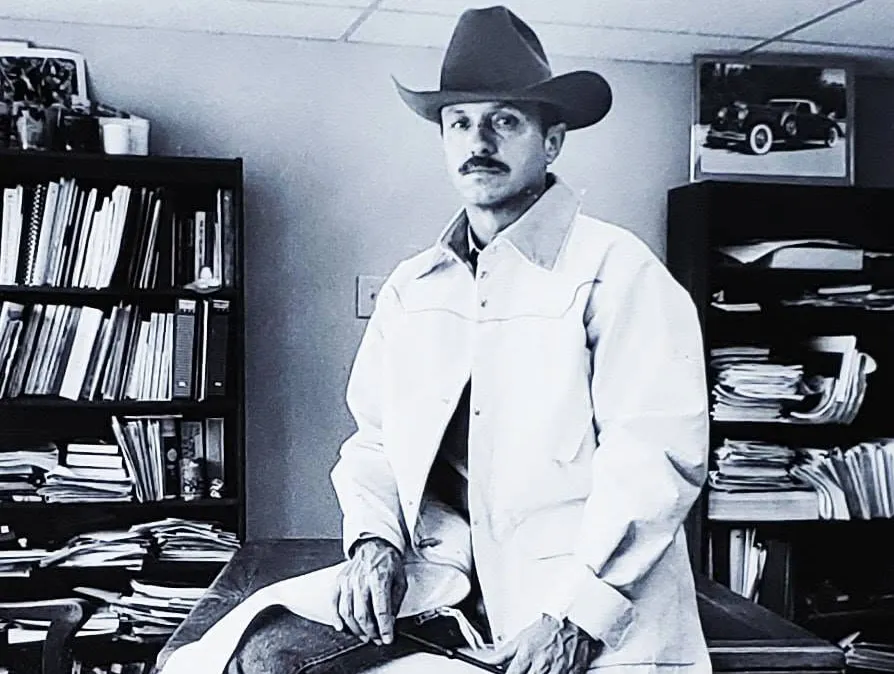
John Peterman in the duster that launched a million similes
Whenever I explained my copywriting job at Woot to someone not hip-deep in ‘00s Internet culture, they usually landed on the same comparison: “Oh, like Elaine on Seinfeld!” That character’s job as head writer for a fictionalized version of the J. Peterman catalogue was indeed a pretty dead-on parallel. We both went way beyond what was necessary or even sensible to make our product copy entertaining and original. Our mockery of retail was right there on the surface while theirs was more implied, but I think I detected a kindred spirit, in both the show’s version of the catalogue and the genuine article.
We’ve talked about Woot here before. Now this week comes news that J. Peterman may finally have met an ending it can’t wriggle free from. After years of purported losses, the company appears to have not taken any orders since July, and their listed phone numbers have been disconnected.
The company has been on the ropes many times before, and always came back. This time, though, namesake founder and driving force John Peterman is 85 years old, and it’s a legitimate question whether he’s got any more flamboyant gambits left in him.
“Uncivilized decibel level”
If this is the end, it’s a sad one for a brand that stayed unusually true to its original weird instincts. At a stretch, Woot lasted about a decade in its peak incarnation; J. Peterman has been doing its thing for 39 years, although a couple of those were under different management.
By “its thing”, I really mean “his thing”. The company’s eccentricities were Peterman’s own. The catalogue itself was like nothing else in that highly standardized field. It’s not just the famed copy, which might start off a blazer description with “Fiona has all-night spat with Beckwith. Uncivilized decibel level, tears, recrimination.” Or muse on how a beret was worn “by jazz oboists, by commandos… by Che Guevara, Tyrone Power, Groucho Marx, Picasso.”
It also called itself not a catalogue but an “Owner’s Manual”, with numbered issues, implying a certain collectibility. Instead of slick product photos, it used hand-drawn illustrations. Even the shape was weird, tall and narrow instead of the standard 8.5”x11” optimized for easy mailing. “I broke all the rules of a catalogue, but I didn’t know I was breaking them,” Peterman told his college alumni magazine in 2001.
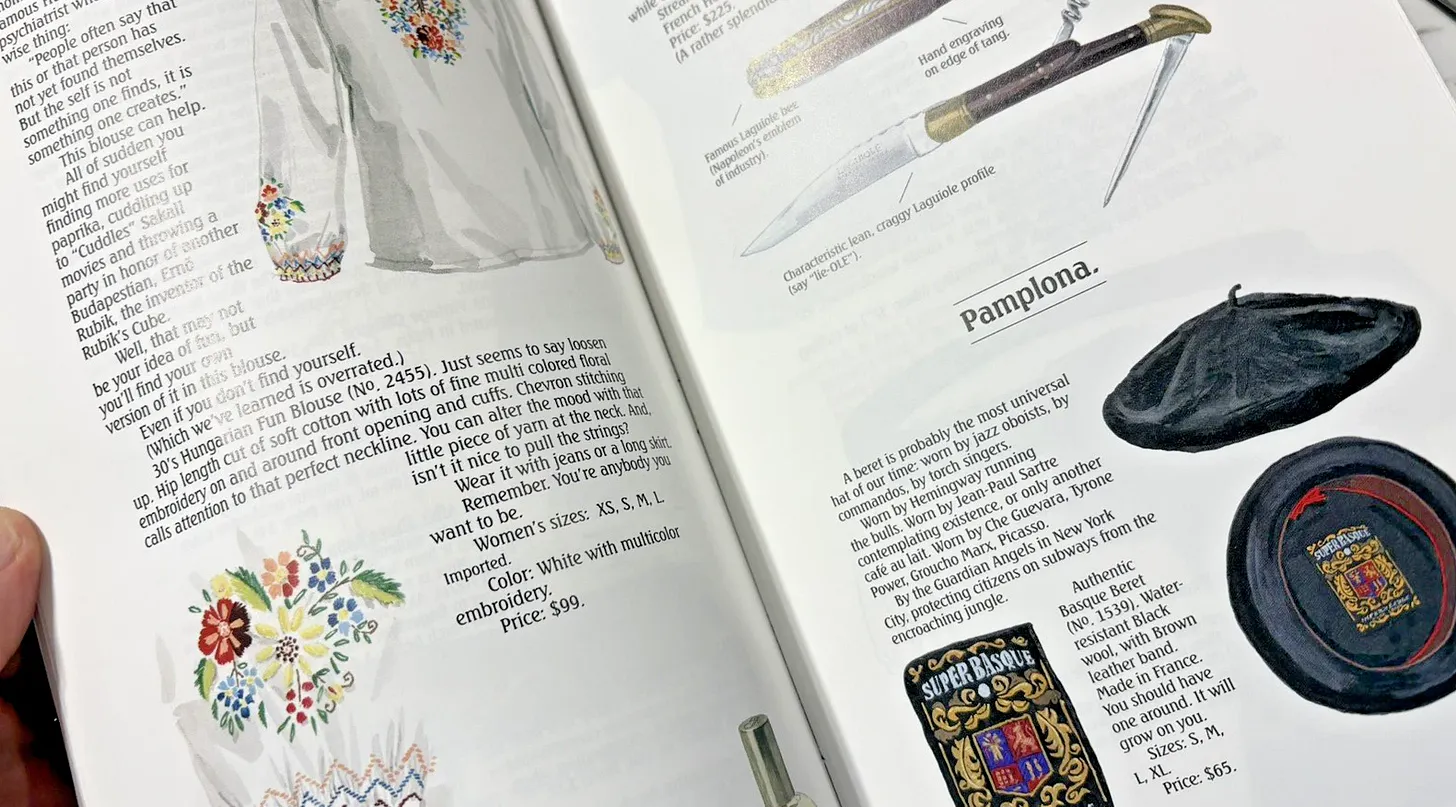
Everybody wants that oboist style
Born in New York in 1941, Peterman played minor-league baseball in the Pittsburgh Pirates’ farm system from 1963-1965. It appears his strength was his good eye: he drew a lot of walks. Years later, in 1986, that same eye was drawn to a floor-length cowboy coat in a Wyoming shop. After receiving compliments while wearing the coat, Peterman - by now a sales manager and serial entrepreneur - and a copywriter friend took out an ad in the *New Yorker *to sell “The Horseman’s Duster”. Thus J. Peterman the company was born.
“A risky modus operandi”
For such seat-of-the-pants origins, Peterman’s creative vision was sharply defined from the beginning. “Unique, hard-to-find items with a little romance attached to them” was how he described it to the Louisville Courier-Journal in 1988.
“Peterman says he sells what he likes, figuring that his eclectic tastes are shared by enough people to keep him in business,” the paper continues. “It’s a risky modus operandi, he admits, ‘but no one has job security except in yourself.’” He was right: the catalogue was profitable from the beginning, and its “factually romantic” copywriting approach got attention.
“As usual, I dropped what I was doing and sat down to read it,” wrote best-selling management guru Tom Peters in a 1990 syndicated column. “The J. Peterman catalog is fun. The products and presentation are ‘world-class quality’ writ large. A few thousand more J. Petermans and we could kiss our economic woes goodbye.”
Of course, J. Peterman’s Q rating really took off when it was noticed by the writing staff of TV’s top sitcom. What’s stunning to me about Peterman’s Seinfeld fame is how young the company still was when it happened. The first catalogue launched in 1988; the show’s “Peterman” debuted in 1995. Like many others, I assumed it was some long-standing blue-chip import-export concern. Maybe that’s down to its old-world, old-money aesthetic, or maybe we were all just mixing it up with Hammacher Schlemmer, an actual old company.
The Seinfeld spotlight, followed soon after by a big score on official Titanic movie replica collectibles, brought a lot of money into the company. But in a familiar story, the sudden weight of success knocked it off-balance. Private equity investment, ventures into brick-and-mortar retail, spending based on projections of $500 million in annual sales (the real figure topped out at $75 million)… “I was trying to go too fast and hit a brick wall,” Peterman said in that same alumni magazine interview. “Revenue was slipping, the banks began pulling credit lines, and there was a flurry of activity to save the ship.”
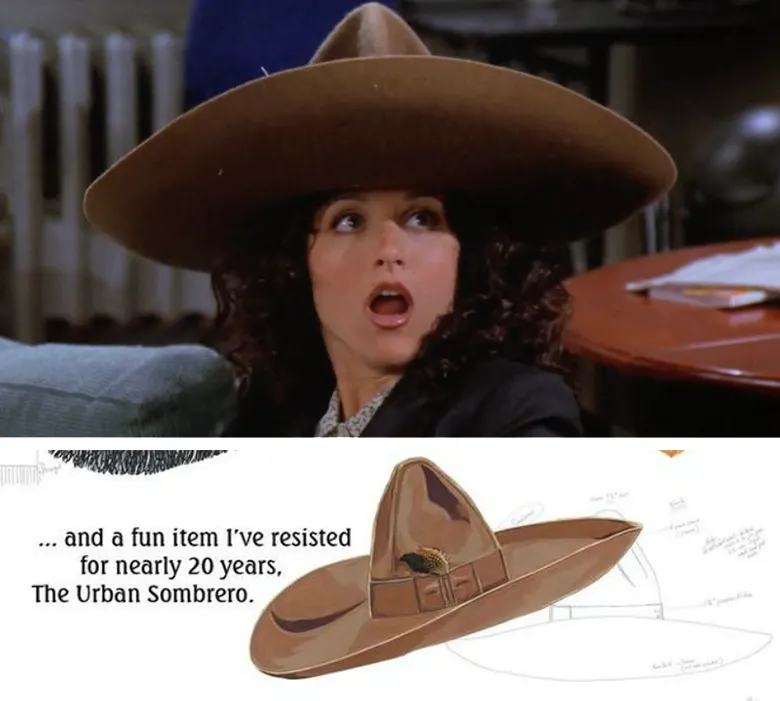
The joke almost became real
That time, it worked. After losing the company in bankruptcy, Peterman recruited new investors, including John O’Hurley, the actor who played his pompous Seinfeld doppelgänger, to buy it back in 2001. More recently, a 2016 Kickstarter finally attempted to bring the Urban Sombrero to life, but fell short of its funding goal. Whatever may be happening now, Peterman has managed to keep the company alive for the quarter-century since his reacquisition of it.
To me, Peterman’s career is better understood not as a businessman’s arc, but an artist’s. The initial shock of the new. Whirlwind fame. Competing pressures. Uncertainty about how to develop. Some flops. Then the settling of a certain equilibrium, and a long steady coda in relative obscurity, as the frontiers move on and some of his innovations are assimilated by the mainstream of his craft. The “rediscovery and reappraisal” phase is still pending at press time.
There hangs a (re)tale
Of course, all this is on my mind quite a bit lately, because part of my day job is restoring the glories of another idiosyncratic mail-order stalwart, the aforementioned Hammacher Schlemmer. At their respective peaks, both Hammacher and Peterman were among that rare class of catalogue that had fans, not just customers. Either one arriving in the mailbox was an event. Both took chances no other catalogues would; both were willing to risk baffling nonbelievers to please their devotees.
Nobody yet, that I know of, has figured out how to translate that peculiar appeal to the Internet age. Meh, to me, is as close as it gets - and I’m not just saying that because they sponsor this newsletter, I’m saying you can tell it’s true because they sponsor this newsletter. Who else would commission someone to write 113 issues (and counting) of these nerdy little stories? And then start up another one with Gnomenclature, the Hammacher Schlemmer newsletter?
Our job now is to prove that in the face of ultra-optimized agentic algorithmic data supremacy, “if we think it’s cool, other people probably will too” can still be a sustainable basis for a store. And to discover what forms can keep eccentric retail storytelling alive now that we know sending 20 million print catalogues isn’t the answer. Wherever you are, John Peterman, thanks for the courageous example.

Imagine trusting your customers to read
It’s likely no surprise that I absolutely love brands that put stories and narrative around their pitches. Along with J Peterman, I used to love getting the old Banana Republic catalogs, back when they kept up their pastiche of faux-yellowed pages, sketches from their ‘explorations’ and visual sketches of their clothes in use in jungle adventures. Do you have any fond memories of catalogs or brands that you loved paging through because it didn’t really feel like ‘shopping’? Let’s talk about it in this week’s Shoddy Goods chat.
—Dave (and the rest of Meh)
previous Shoddy Goods stories:
And if you like Shoddy Goods, don’t miss Jason’s new other newsletter, Gnomenclature. Every week he digs into the 178-year-history of Hammacher Schlemmer, America’s oddest retailer. It gets weird!
- 17 comments, 9 replies
- Comment
Herter’s. IYKYK.
@werehatrack Copy written, of course, by George Leonard Herter.
Damn, I just found a J. Peterman shirt I ordered wore for a while, then it got put in a box in the early 90’s. I get a lot of complements when I wear it and am asked “Where did you get it?”.
Also have a couple of shirts from the Territory Ahead, also a Peterman brand, sank with the ship…
American Science and Surplus. Much like J Peterman, it had illustrations rather than photos, and funny copy that convinced you to order 50 military surplus canteen bags (no canteens), or a bag of tiny motors used for cell phone vibrate alerts. Likewise, they no longer run their online store or mail order side, but two employee-owned brick and mortar stores persist. Long Live Jarvis.
@cainsley Oh, hell, yes!
@cainsley I came here to say just this! So much delightfully weird stuff in my house is because of them. The rocket launcher ammo boxes still make for great storage.
The factory that used to print a large percentage of all the catalogs ever made is now the factory for the new Slate truck. That’s my trivia for today.
Ooh, how about the Dak catalog? Anybody remember that one? I actually bought quite a lot of stuff from them in the 90’s.
@ETFrisco We got a bunch of stuff from them. Had this for years until our last move:

@aetris Yeah, Dak’s catalogs were so fun to read! Basically, the copywriter there said that HE had the best job, because he got to try out all the neat products they were offering! I bought a bunch of X-10 products, (gone now) and one of their 2 pound bread makers which is still collecting dust on my kitchen counter!
@ETFrisco You beat me too it. I remember getting it in College and actually it was a lot like a paper “Meh” - full of bizarre items with writeups to convince you that they were incredible. I still remember the early ink jet printer I got as well as a double tape deck (they were a “thing”) I convinced my roommate to buy.
@ETFrisco Copywriters can be a lot of fun to read, but they have a lot to answer for!
Private equity strikes again
Not a mail-order catalog, but the circular from Building 19 (a Massachusetts-based discount/warehouse store) was always a highlight for me. Brilliant write-ups paired with illustrations by cartoonist Mat Brown. The store is long gone, but the advertising lives on in a coffee table book.
Ugh, this is the worst news I’ve heard in a while! Probably since the news that Amazon bought woot!
I actually have some stuff from J. Peterman, my fondest one is my “Baseball Glove Leather Wallet” that I bought in 2008 to replace an old CHAPS branded wallet that literally fell apart. The J. Peterman wallet is still rockin’, a bit worn…well, Peterman would call it “Just broken in!” but it’s still together with only one stray frayed thread
That was the thing, though. That wallet is just like everything from J. Peterman. It wasn’t necessarily cheap but it was outstanding quality! I even had a new attaché bag in my cart to get as a gift for my step-daughter as she starts her own professional journey into the world and I was heart-broken that the site was down and now I can’t get it at all.
Next thing you’re going to tell me is Slashdot is hanging up the aggregator business.
BTW, I have a Dyson canister vacuum that I bought on woot! for a fraction of it’s retail price. That’s still working and I use it regularly.
TIL that J. Peterman was based on a real catalogue and person. Wow
@jsh139 There’s a Harvard Business Review article with the real Peterman talking about the Seinfeld satire, it’s on the web.

I always loved getting the Archie McPhee catalog back in the 90s. Any time I was in Seattle I’d make a pilgrimage to the store.
Yes to DAK. Also C.O.M.B. and Damark. Which ended up very intertwined. https://www.encyclopedia.com/books/politics-and-business-magazines/damark-international-inc
The Johnson Smith catalog when I was young was always fun. It was printed on newsprint and was about 5x7 and filled with cheap stuff like…many things! I also liked surplus catalogs like Meshna (I hope I got the name right-they were in Eastern Massachusetts). I ordered from both. And there were others.
@andyw i once had an order from Johnson Smith that wasn’t delivered. i wrote and asked for a refund. it came as an envelope of odd stamps. (i was a kid, it was probably less than $2. and then the stuff finally showed up a few weeks later.)
Early (pre-1970-ish) Eddie Bauer catalogs were fabulously descriptive.
I thoroughly miss the Radio Shack catalog. Always looked forward to new offerings and sometimes price drops on things I wanted. And some the write-ups were quirky as well!
I forgot to mention above the Lafayette electronics catalogue for consumer stuff in the 60s and 70s and the Allied Radio catalogue, based in Chicago, I think, of electronic stuff, mostly parts and geared towards industrial users, but, for some reason, fun to read,.
I used to be quite fond of Banana Republic, both the catalog and the aesthetic.
Okay, this one hurts. A lot. The first truly nice shirt I ever bought myself was a cream-colored silk button-down from J Peterman; 35+ years later and I have still never encountered silk that substantial. I have easily a dozen of their long-sleeve t-shirts, which are likewise substantial, and probably a quarter of my dress shirts are from there as well. Best and most beloved in my closet, I have one stripey, coarse-woven cotton J Peterman that I bought not from the catalog but at a night market in Chiang Mai. They will bury me in that shirt ISTG. Thanks for the years of happy shopping and delightfully insane reading, Peterman…