How We Got From 'The Goat' to 'The GOAT': A Real American Story
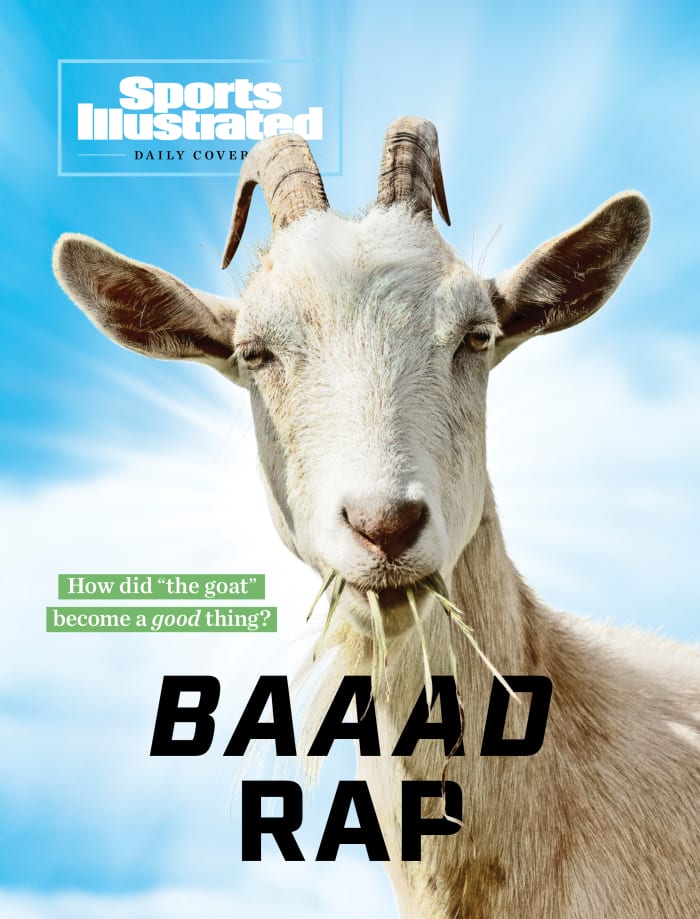
7He used to be the fall guy. Buckner. Bartman. Now he (or she) is the greatest, often in his own eyes. MJ. Tiger. How did this barnyard pejorative turn into a boast? What does the shift say about us? And, uh, where does LL Cool J figure in all of this?
A Sports Illustrated article
https://apple.news/A0J3n5j9HQ2OYbk-E8mqiZA
Or
https://www.si.com/nba/2020/05/26/the-road-from-the-goat-to-the-goat
“If you don’t make it, you’re the goat. If you make it, you’re the greatest of all time." —NFL quarterback Doug Williams, December 1988
Here’s the opener
Before people said Tom Brady had surpassed Joe Montana as football’s GOAT … before golf fans argued about whether Tiger or the Golden Bear is the GOAT … before you could type goat.com into your browser and get a site trying to sell you Air Jordans … before a clothier named Greyson pitched an “iconic GOAT polo” shirt as “everything that we stand for and everything that we want to be” … before you could watch Jeopardy!: GOAT … before LeBron James vs. Michael Jordan became the GOAT of GOAT arguments … before all that, the last thing you wanted to be in sports was the goat.
A goat was the opposite of a hero. A goat cost his team the game. Fred Merkle, whose baserunning error helped cost the New York Giants the 1908 pennant, was a goat. Fred Brown, who passed to the wrong team at the end of the '82 NCAA men’s basketball championship game, was a goat. Every Cubs fan knew Leon Durham was a goat, and every Cowboys fan knew Jackie Smith was too. When Chris Webber called a timeout that his Michigan team didn’t have in the 1993 title game, newspapers across the country declared he was “the goat” or “wore the goat horns.”
Like some of Jordan’s best dunks, the word goat has done the rarely seen etymological 180: It now means almost the exact opposite of what it used to mean. If you weren’t paying attention, you might have missed the change. A few years ago, former NBA player Craig Ehlo was watching a Finals game when his son Austin declared “LeBron is the GOAT.” Ehlo was confused; he had never heard the acronym for greatest of all time before. Ehlo was the Cavalier guarding Jordan when MJ hit The Shot, in 1989, and at the time Ehlo seemed like the goat on that play—but as it turns out, Jordan was. If that seems weird, consider Mariano Rivera’s journey: He went from goat (in the '97 and 2001 postseasons) to the GOAT of relief pitching.
Now, GOATs are everywhere, often in emoji form. When Phil Mickelson announced that Brady would be his partner in last weekend’s charity match against Tiger Woods and Peyton Manning, he tweeted, “I’m bringing a.”
“I’m feeling a lot of energy around the GOAT,” says LL Cool J, whose 2000 record, G.O.A.T., helped spread the GOAT gospel. “People are going down the rabbit hole and doing their own research. … This did emanate from LL.”
Well, it sort of did. Muhammad Ali called himself the Greatest of All Time first, and he named his company GOAT. (Authentic Brands Group, which owns SI, also handles licensing for Ali’s estate.) But LL helped take it mainstream. So ride that goat down the rabbit hole with us. This is not just a semantic discussion; the word’s evolution mimics America’s.
LL Cool J had two goats in mind when he dropped G.O.A.T. One was Ali. The other was Earl (the Goat) Manigault, a New York streetball legend. To understand how goats became GOATs, you must understand both the GOAT and the goat.
Haven’t read the whole thing yet, but I love it when SI goes discursive in a good cultural topic. They are known to have a decent writer or two hanging around.
The article starts w discussion of people like Ali and Namath. So, for people with whom this resonates, it should be a rewarding, nostalgic read.
- 2 comments, 1 reply
- Comment
@DrWorm doesn’t celebrate Mother’s Day because they think it’s a Hallmark Holiday.
LL is the G.O.A.T.
@f00l