TV lamps: Shoddy Goods 062
4
I’m Jason Toon and I’m not a valuable consumer—because I buy so much stuff at thrift stores, yard sales, and secondhand online. This issue of Shoddy Goods, the newsletter from Meh about consumer culture, looks at an item that used to be easy to find in those venues, but which has gotten a lot more rare.
The coming of television didn’t just transform where people put their living-room furniture. It was a big change for the human eye, too. For the first time ever, ordinary people could stare at a glowing screen for hours in the comfort of their own home. The early televisions were small and not especially clear, so early viewers tended to sit close and stare hard. And since the tubes weren’t especially bright, it helped to watch in the dark.
It didn’t take long for some of those bleary proto-bingers to start feeling some eye-sizzle after another marathon throwdown with Uncle Miltie and the Ricardos. Uh-oh, was watching TV in the dark bad for your eyes? The machine of industry did what it does best: head off concerns about one product by coming up with another product. Thus began the brief shining moment of the TV lamp.
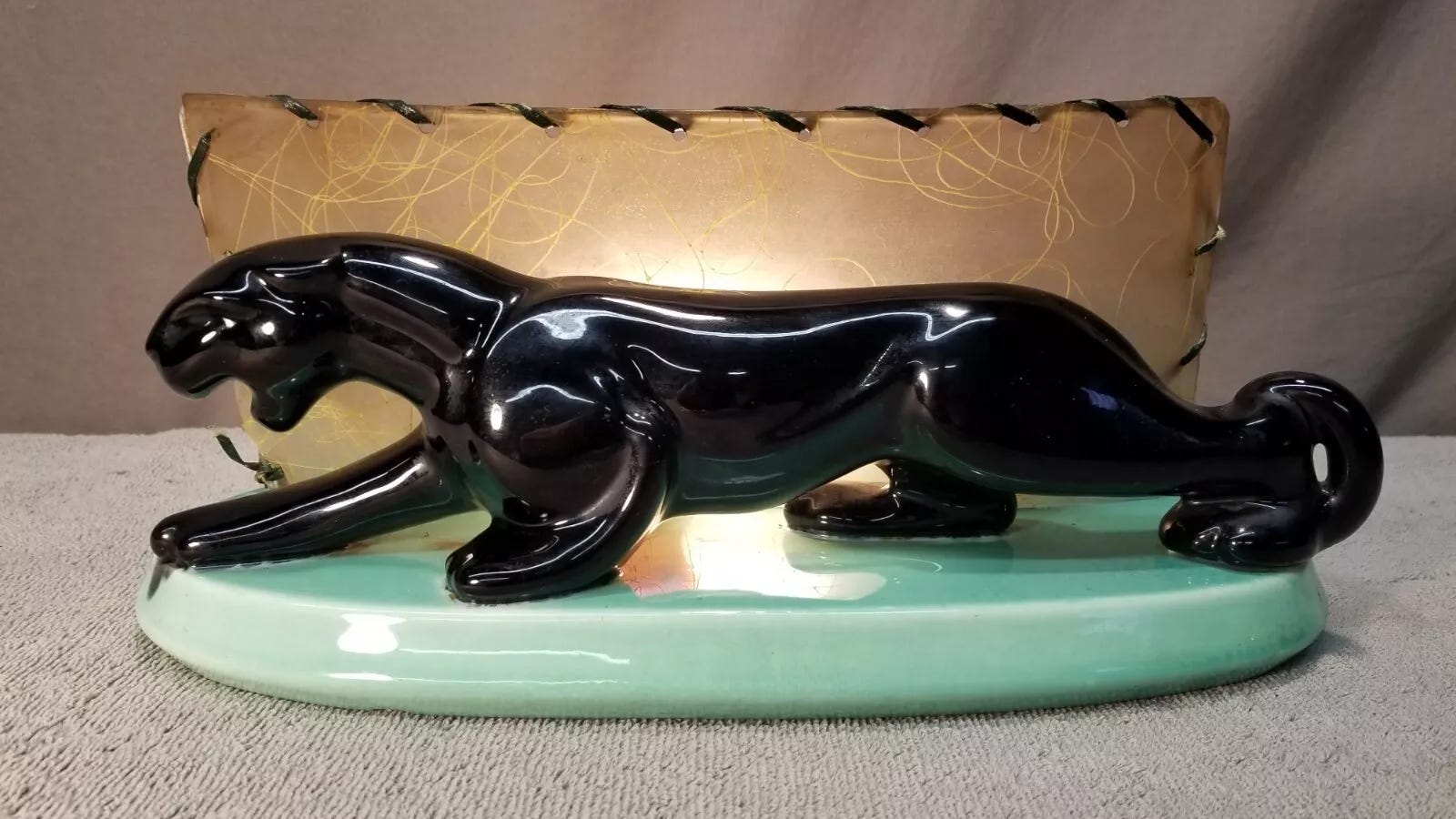
Only marginally less interested in you than a real cat
“Approved by leading doctors”
There wasn’t really any evidence for that fear. In 1949, the British Association of Optical Practitioners advised for comfort’s sake not to sit too close to the TV, or at too extreme an angle. But otherwise, they said, “Television itself is not harmful to the eyes.” A paper that same year in The Sight-Saving Review by Dr. Benjamin Rones likewise found “It is not that the eyes are damaged by television, but rather that television is demanding more accurate use of the eyes, and therefore the correction of small errors to promote their comfort.”
Commercially, the truth behind the fear mattered less than the fact that people believed it. The lightbulb moment (sorry, but not that sorry) came in 1950. What America needed was a lamp that was bright enough to reduce contrast in the room, but dim enough to keep the picture visible, and that cast its light indirectly so there was no glare on the screen. Suddenly TV lamps were everywhere.
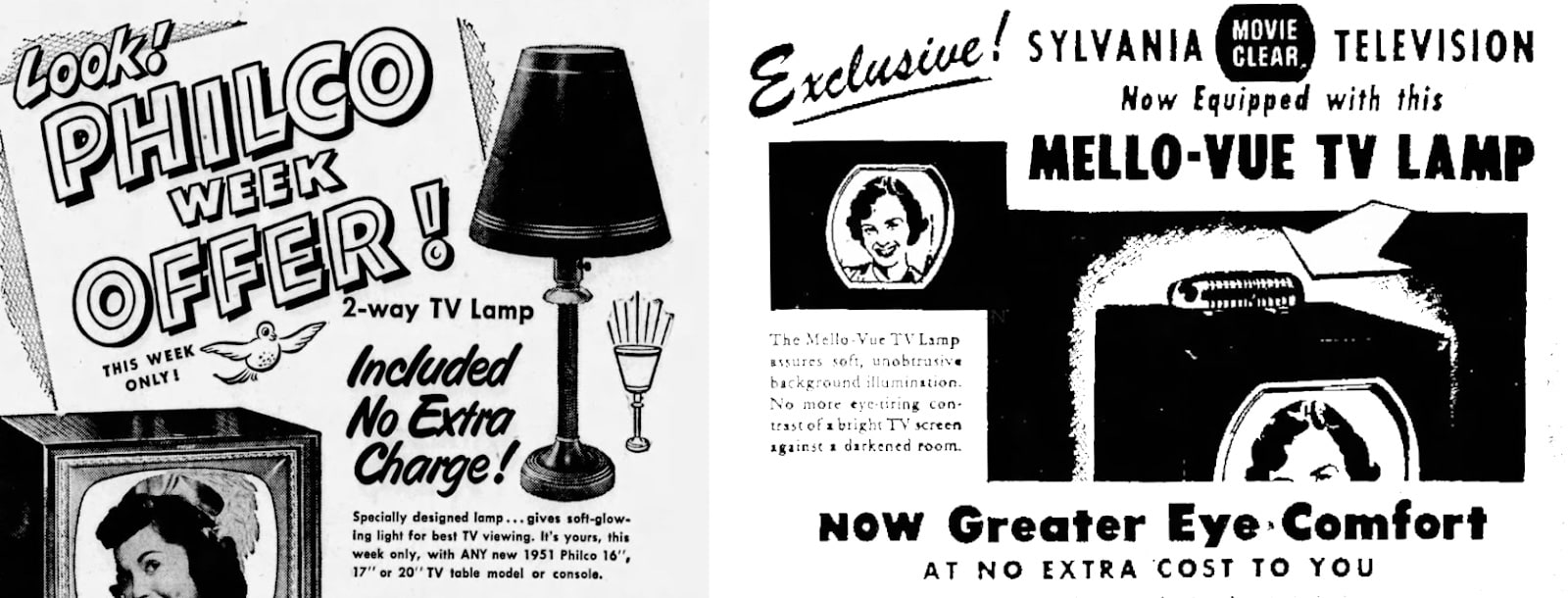
Now with You-Won’t-Go-Blind-O-Vision!
“Clearer pictures! No eyestrain!” blares a 1950 ad for the Maxilume lamp company. “This scientific development approved by leading doctors gives enough light to prevent eye strain but NOT so much that it interferes with vision.” TV manufacturers themselves moved to inoculate their products from the issue, with Sylvania adding a “Mello-Vue TV Lamp” to its models, and Philco dealers giving away a stand-alone lamp with every purchase.
Knick-knacks by day, lamps by night
A thousand TV lamps bloomed. Some were recognizable as lamps, some were swooping Space Age rocketships, there was at least one that you bolted to the back of your TV. “TV lamps are almost unique in the insane diversity of their solutions to such a simple functional need,” write Leland and Crystal Patton in their book Turned On: Decorative Lamps of the Fifties. But the ones that are best remembered are the weirdest ones of all.
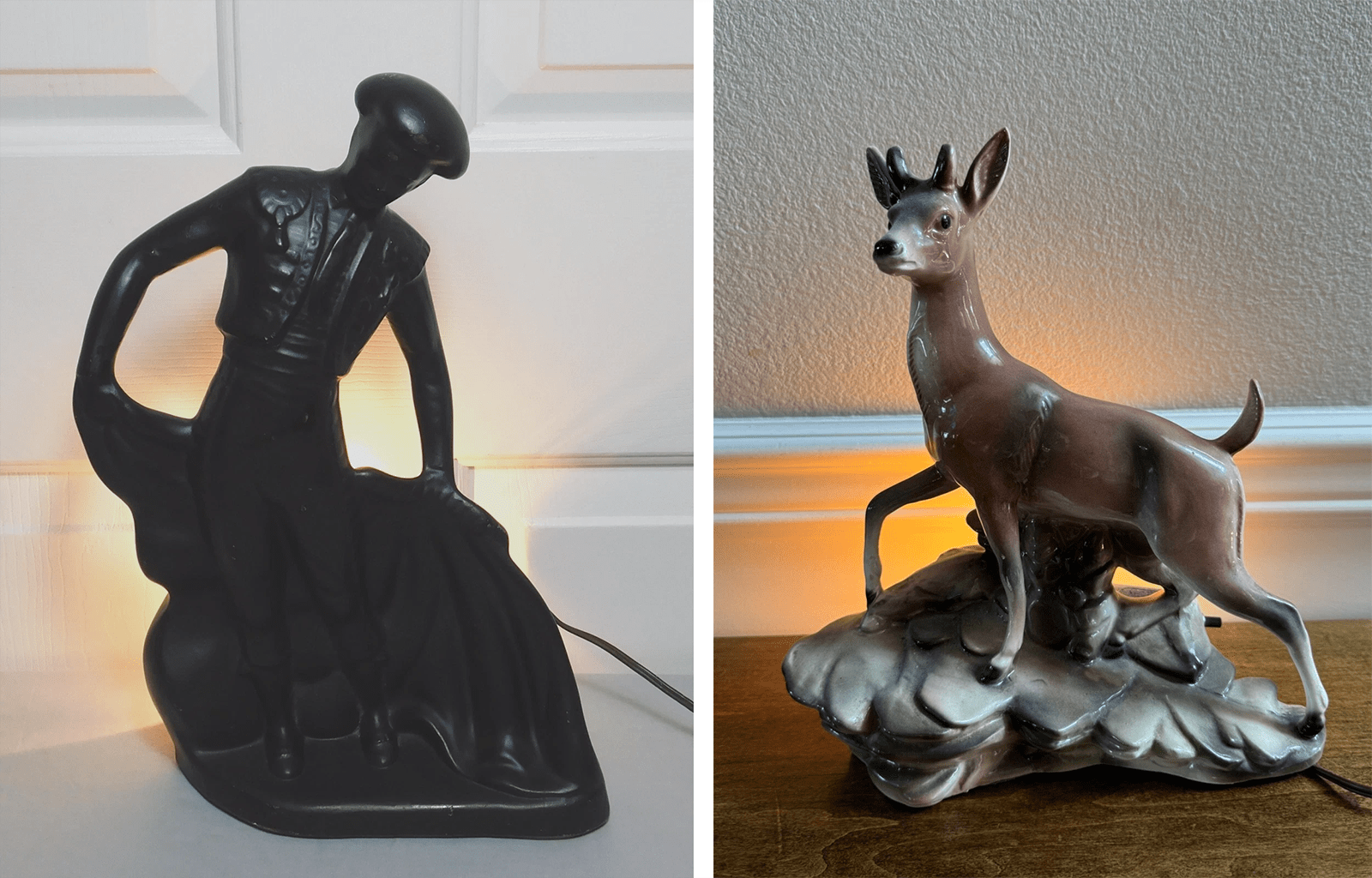
Real tough guy, fighting a deer
The general '50s fad for ceramic sculptural lamps was a perfect fit for the TV lamp. Their smaller size meant the fanciful designs wouldn’t overwhelm the decor like full-size ones could. And their curves, folds, and hollows were ideal hiding places for the lightbulbs.
“The figures most often represented in TV lamps were Siamese cats, panthers, dogs, mallards, ducks, swans, and ships,” writes Calvin Shepherd in the book '50s TV Lamps: A Collector’s Guide. There was also a healthy proportion of exotica like matadors, “Chinese” figures, and covered wagons. “These were glazed and painted in popular 1950s colors like green (chartreuse), maroon, white, black, and pink.”
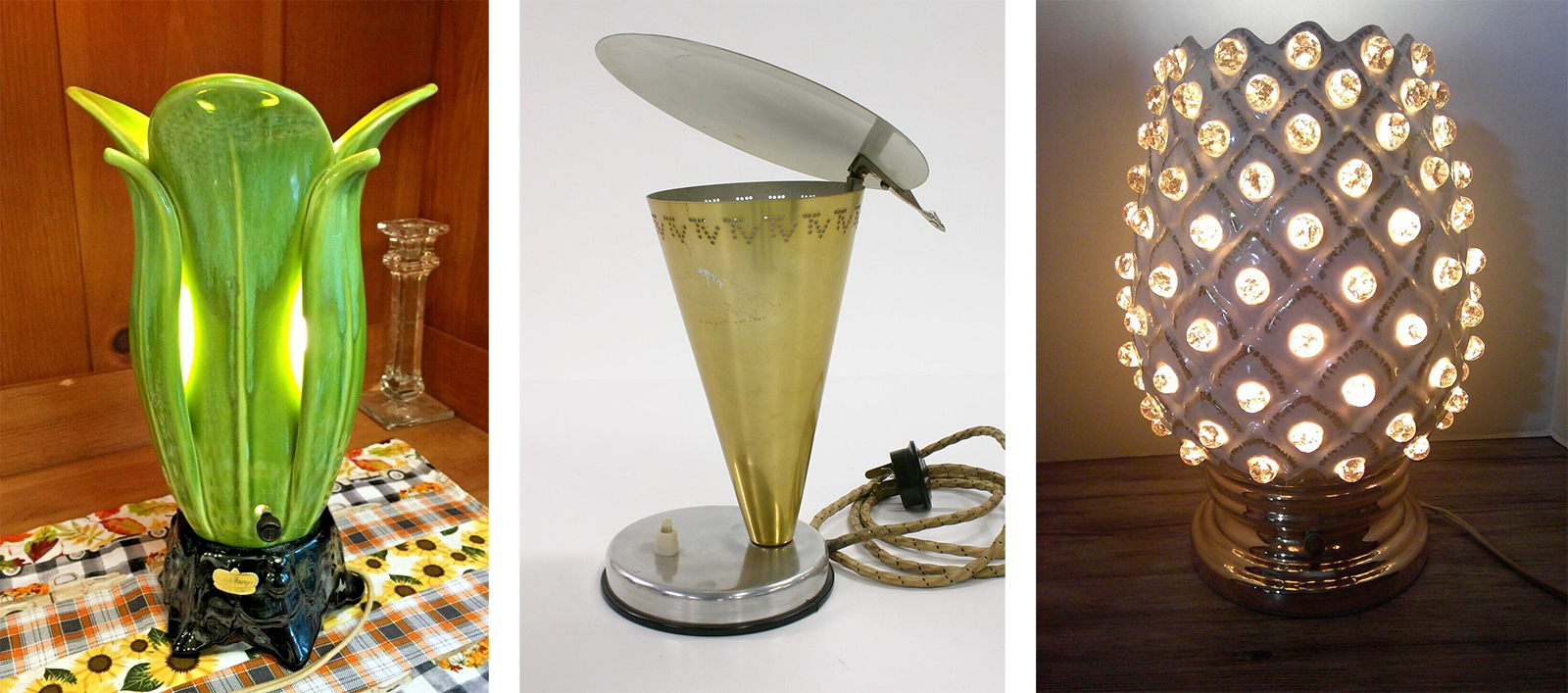
Yes, the middle one says “TV” over and over around the rim
As TV ownership grew from 1% of US households in 1948 to 75% by 1955, legit household ceramics companies got into the act. Haeger, Lane, and Maddux are among the recognizable names who made a play for a piece of the action.
Fade out
And that’s why we all have TV lamps today… no, wait, we don’t. Through the '60s, TV tubes got brighter, the images sharper, the screens bigger. You didn’t need to hunch six inches away from the TV in a darkened room to see what mess Lucy had gotten into now. As people watched TV for years without any apparent damage to their eyes, the fear faded away.
Ceramic sculptural lamps in general also passed out of fashion and into the dustbin of kitsch, whence they’d be rescued in later decades by aficionados of vintage style. Original TV lamps will generally set you back at least $75-$100 now, but my wife and I accumulated a few back when they were easy to find in thrift stores. My heart aches to think of our “Chinese boat” TV lamp which has been sitting in our storage space since we moved out of the US. Someday we’ll be together again… someday…
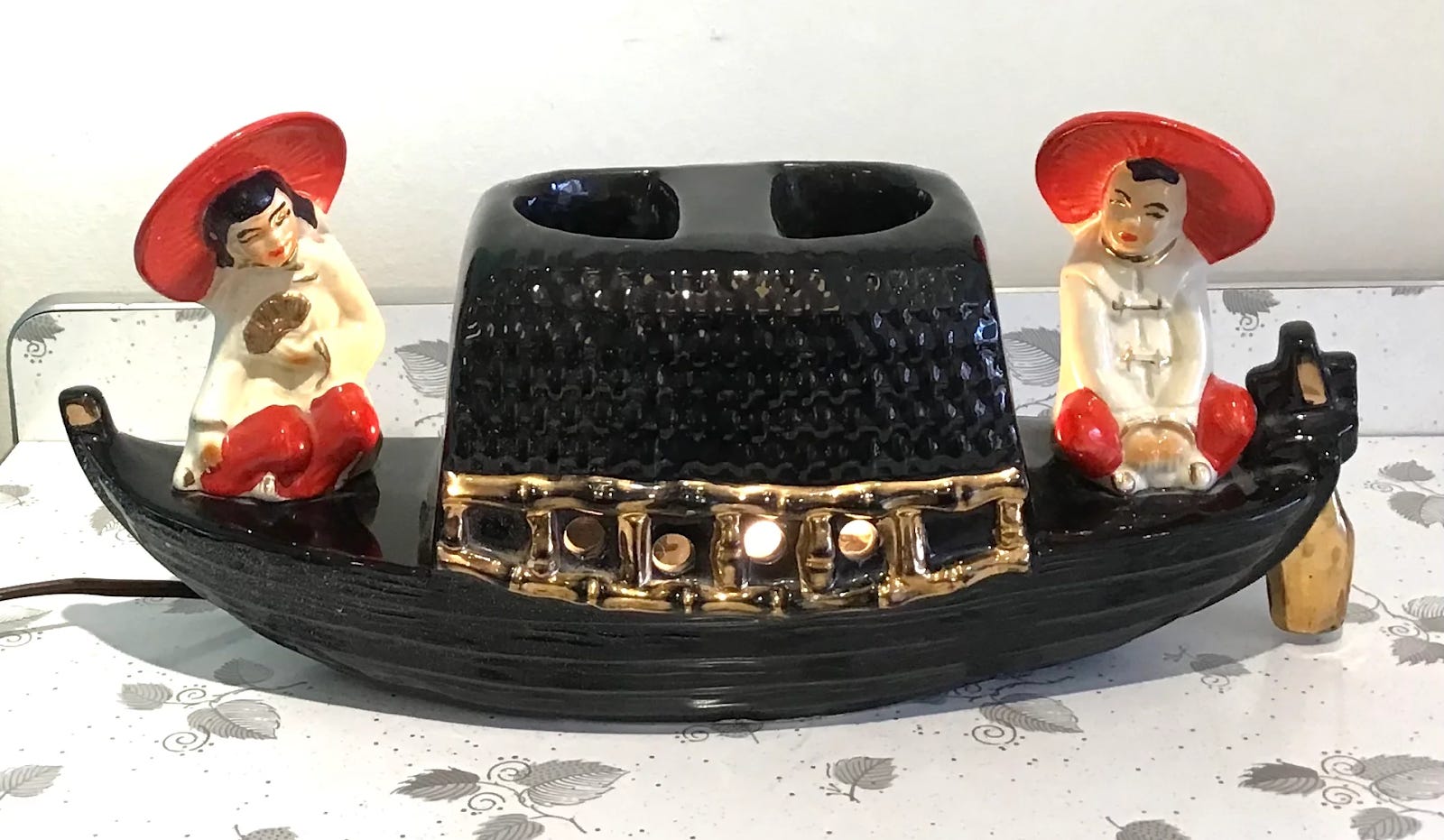
Not exactly ours but the same model, in much better shape 
There’s one last twist to the tale: in 2005, the New York Times took on the issue of whether watching TV can hurt your eyes. The answer was no… not anymore. Early TV sets “emitted levels of radiation that after repeated and extended exposure could have heightened the risk of eye problems in some people, said Dr. Norman Saffra, the chairman of ophthalmology at Maimonides Medical Center in Brooklyn,” the paper wrote. “‘It’s not an old wives’ tale; it’s an old technology tale,’ Dr. Saffra said.”
So the job TV lamps were invented to do was real. They just weren’t the tool to do it. Maybe Philco should have given away radiation suits.
Huh, I’ve never heard of TV lamps, but I did hear “Don’t sit so close to the TV, you’ll hurt your eyes” every Saturday morning. It now seems more likely reading books led me to my high-powered prescription than those cartoons.
Similarly, apparently it’s perfectly fine to go swimming right after you eat despite the constant threats we heard that we would cramp up and drown if we got in after only 29 minutes. Remember any other urgent parental health proclamations that now seem to be overblown? Let’s hear about ‘em in this week’s Shoddy Goods chat.
—Dave (and the rest of Meh)
If TV hasn’t rotted your eyes out of your head, take a look at these Shoddy Goods re-runs:
- Vanitory dreams: when Formica took glamour to the bathroom
- The ethnic stereotype behind Scotch Tape
- There will probably never be a new physical media format
Huh, I’ve never heard of TV lamps, but I did hear “Don’t sit so close to the TV, you’ll hurt your eyes” every Saturday morning. It now seems more likely reading led me to my high-powered prescription than those cartoons.
Similarly, apparently it’s perfectly fine to go swimming right after you eat despite the constant threats we heard that we would cramp up and drown if we got in after only 29 minutes. Remember any other urgent parental health proclamations that now seem to be overblown?
- 14 comments, 29 replies
- Comment
Eye Patches. I had a drifting eye, (Still do, but I got better controlling it) so Ma would stick a BANDAGE over my eye. It was terrible. I still get phantom feelings if I think of it. Eugh. Thank God they don’t really exist anymore.
@Wollyhop what doesn’t exist?
@Wollyhop oh but they do.
I’m going to tell this story because I think the funny outweighs the cringe. Remember that I am fully acknowledging that I am the asshole in this story. I was mortified when I did it.
A few years back I went to a Taco Bell drive through. I placed my order and the gentleman told me my total. $4.62.
I pulled up to the second window as instructed and in a few seconds I was greeted by a voice saying that’ll be $4.62 please. A tattooed arm extended from the window, and as I went to meet his hand with my five dollar bill I followed the arm up to the man extending it.
He seemed tall, a bit burly, brown hair that was mildly wild, and he had a full on black eye patch over his right eye. Other than the fact that this was a Taco Bell and not a galleon at sea, he was the living picture of a pirate. It was not anywhere near Halloween, so I believe it was likely medical and not a costume piece.
i was already moving my mouth to say “all right” but what came out of my mouth was “Arrrrright”.
I felt terrible.
@djslack It is okay
Pats back
The best thing is that you admitted it. This is a important step in the recovery process. I’ve said some bad stuff (Not going to say here, don’t have time) but in the end, I knew it was me, and me alone.
@djslack @Wollyhop I spit my coffee when I read that! This was so likely something I would do without thinking! The only thing I might have added was “matey.”
Are TV lamps used when you need extra illumination to eat your TV dinner?
@werehatrack Hmmm …
/showme Person watching TV and eating TV dinner with hot lamp to keep the food warm.
@cfg83 Here’s the image you requested for “Person watching TV and eating TV dinner with hot lamp to keep the food warm.”
My mom used to freak out if I tried to go outside too soon after a shower because I would catch a cold due to my pores being open. I never was able to talk sense into her on that one. Sheesh.
@Pony My mom didn’t like me leaving the house with wet hair. I’ve never heard anyone complain about ‘open pores’.
I have a TV lamp that looks like a horse head in profile.
@user92977666 My grandparents had one that was a Conastoga wagon and the way it turned on and off was pulling down on the horse hitch part that was cleverly attached to a bead chain. It was a souvenir from somewhere like the Great Smoky Mountains or Rock City or something like that. I would give anything for that small piece of their lives!
@user92977666 Hmmm …
/showme A horse head lamp that looks like a TV in profile.
@cfg83 Here’s the image you requested for “A horse head lamp that looks like a TV in profile.”
Remember when we used to smear neon orange mercury laden paint on cuts and scrapes because we thought it was healthy? A shout out to Mercurochrome!
@soxnabox I never knew this…and it’s right there in the name! Wow, directly into the bloodstream on open cuts and scrapes!
@mdiaz @soxnabox That stuff sucked. My dad had a zillion year old bottle laying around that he would occasionally use on a shaving cut. Stuff hurt like hell AND contained mercury?? Wtaf…
@soxnabox Best drank straight from the tiny one ounce bottle! I mean if you are going to commit suicide why do it slowly! LOL. Remember it was applied using this glass rod attached inside the lid! Wow what a totally safe product. Just an FYI you might have never heard of. One of the treatments used for inflamed tonsils/sore throat back then was to “paint your throat” using, you guessed it, Mercurochrome on a huge cotton swab.
@kenrose @soxnabox
In reality the mercury exposure from your dental filling was probably much higher.
@soxnabox Yeah, I miss it. Too bad it was bad for me. Mercurochrome Henna could have been a thing.
@kenrose @soxnabox I thought that glass rod was totally cool.
I just realized that with an led you could make a small light saber for a Yoda.
The Lustron house at the Ohio History Center museum has this lovely panther example:
@cainsley I love that antenna rotor!
Something about going blind. I won’t go into details.
@ckcarlton
Which significantly increases your odds of nicking yourself shaving your palms…
How weird, I’ve certainly never tried a Mediocre product that was supposed to reduce eyestrain while watching TV…
@ArmchairGamer I have a set of LED strips across the back of my TV with a camera that synchronizes the colors to the picture on screen. But not for eye strain. Just because it’s cool.
It does make it more relaxing to watch at night with the lights off, though.
@djslack That synchronization is pretty cool!
@ArmchairGamer @djslack I still want a Philips Ambilight TV! Very novel.
Just want to mention Kron since I didn’t see them mentioned. I’ve got one of their owls and the white and gray variant version of the panther with the base. (Still trying to find the black version for a reasonable price to pair with it, despite being more common.) Also have the stand alone version of the stalking panther in the newsletter and it will be going in my tiki bar with a flame bulb as soon as I have a house and build it.
@KlarkKent13 Drat, I didn’t know anything about these but I looked them up and now I want one.
/showme Meh tv lamp
/showme androids other than the ones they are looking for
/showme Meh TV lamp
I was not allowed to go near the houseplants while menstruating, my mother believed the old wives tale that it would kill them. And that’s just one of many. Scarred for life and still in therapy.
Anyone remember Sylvania’s ‘Halolight’ sets, that had a fluorescent tube encircling the CRT as a way to reduce eyestrain? Still want one of those.
@PooltoyWolf I think those are the only TVs they have in the Vatican,
My grandparents had the first Panther or one very similar to it.
I thought it was very cool.
Unfortunately (for me) my grandma constantly acquired and got rid of stuff.
One visit it was there, the next one it was gone.
I never found another back when prices were low.
Now the lamp will srt you back more than a big screen TV.
@Garfield43 I have one of those panthers that is long and low to the ground. It’s about 5.25” long. I wish they were worth something.
https://www.amazon.com/OkiyiD-Stepless-Dimming-Function-Decoration/dp/B0CGH2T6TL
https://www.amazon.com.au/Suewow-Silicone-Dimmable-Nightlight-Rechargeable/dp/B0C36B3632