The water guns that looked too real: Shoddy Goods 096
2
Hey, Jason Toon here with another Shoddy Goods, the newsletter from Meh about consumer culture. Like many a current and former boy, I still have a soft spot for pretending to shoot things. I am less interested in getting shot for real. This week’s story is about a moment when our culture had to decide how to set the balance between the two.
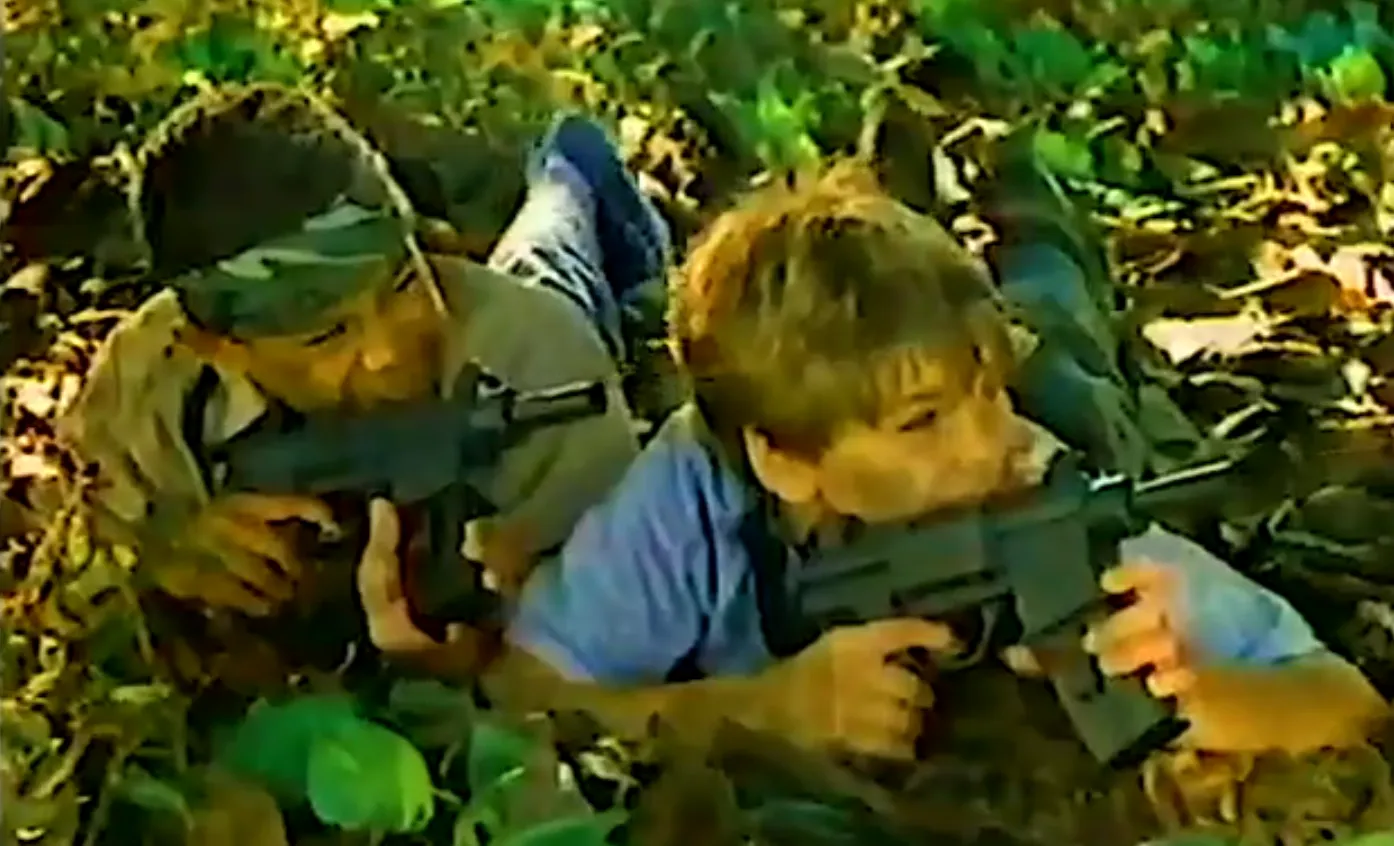
Ms. Johnson’s fourth grade drama class presents: PLATOON
“The look! The feel! The sound! So real!” Forty years later, the 1986 commercial for Entertech water guns is a little unnerving: all-American suburban kids toting authentic-looking automatic weapons. Maybe we’ve seen too many real-life child soldiers since then. Or maybe we’ve just gotten used to toy guns having gaudy, obviously unrealistic colors - a shift Entertech played a major role in instigating.
Entertech wasn’t the only realistic toy-gun line at the time. But the manufacturer, LJN Toys, staked the entire brand on the resemblance to real deadly weapons. When the mood abruptly shifted after some high-profile tragic incidents, the Entertech name lost its value, its reason for being, and its existence.
“The play value is tremendous”
I was the target market for these water guns. Twelve years old at the time, I was still young enough to run around playing make-believe but old enough to crave some edge, some realism. I wasn’t even that into the Stallone/Schwarzenegger brand of action - my tastes ran more to superheroes and Indiana Jones - but come on: those Entertech guns looked awesome.
US sales of toy guns - “war toys”, in pacifist parlance - had dropped steeply through the first half of the decade, from 33 million units in 1980 to 19 million in 1985. The generation that marched against Vietnam were hesitant to put toy guns in the hands of their kids. Consumer advocates had opened up discussions in the 1970s about the connections between pretend violence and the real thing. But as the post-hippie generation grew up and had kids of their own, there was less of a stigma against toy guns.
“I think today’s parents may be less averse to guns than many suspect,” said industry analyst Paul Valentine in 1986, “because they generally missed the height of the anti-war movement of the late ‘60s and they generally were not affected by the draft.” The same trends that made Rambo box-office gold showed up in the toy aisle, too, including licensed Rambo toys by at least three different companies, including LJN.
New technology also made toy guns a hot commodity. Worlds of Wonder’s Lazer Tag made it possible to play “for real”, with points and confirmed kills, and rapid-fire water guns like Entertech brought the chugga-chugga of action-movie battlefields to the backyard.
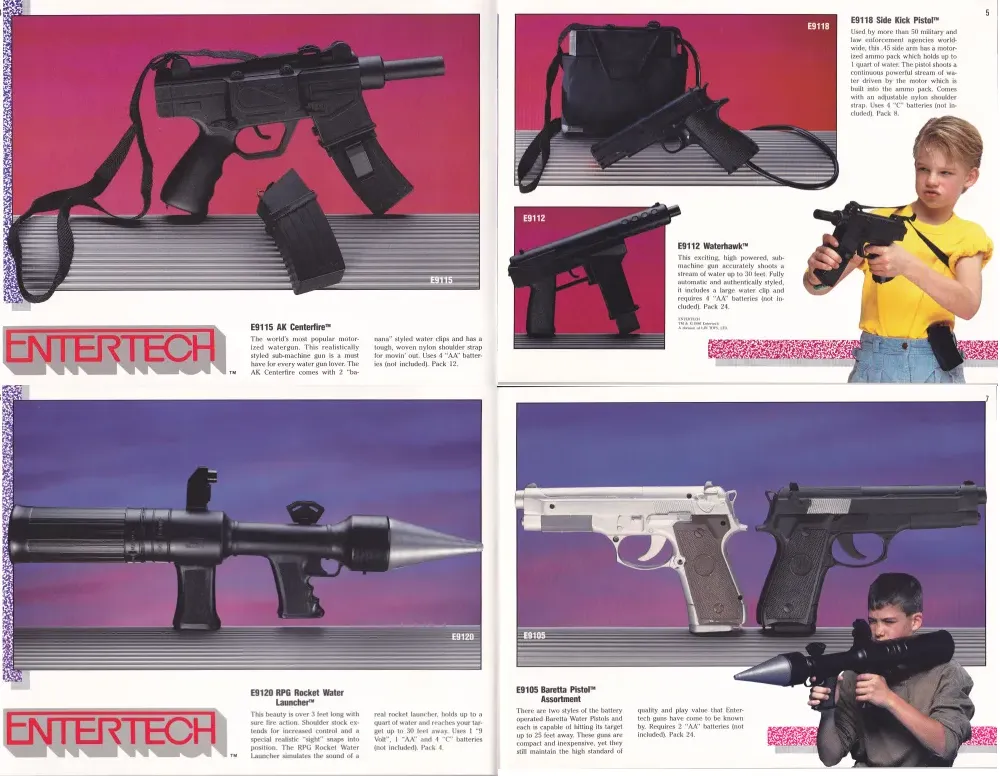
Say hello to my little friends’ little friends
“The motorized water machine gun category is one that we think is going to grow,” said Leo Hoffman, LJN’s director of marketing, in the same news story. “The product has really universal appeal. The play value is tremendous, really.”
My friends and I would have agreed, if any of us had been lucky enough to have an Entertech. Authentic-looking M-16s and Uzis with automatic bursts of “fire”, 30-foot range, changeable water-filled “clips”… what’s not to love?
“Children have a built-in gun”
Of course, just because kids want something doesn’t mean it’s the best idea to give it to them. The toy industry at the time did what industries do: shrug off any responsibility for the even the possibility of harm from their products.
“We don’t create the trend in the market,” said Steven Kort, VP of marketing for a toy company that marketed a replica Baretta dart gun called “The Real Stuff”. “We just react. And we know that right now, the more realistic, the better.”
Penny Richmond, publicist for the Toy Manufacturers of America, said “”We don’t consider any of the guns or action toys ‘war toys’. Look, children have a built-in gun - they cock two fingers of one hand and bang-bang, they shoot their little brother or whatever. Kids have been doing that since ancient time.”
Richmond’s questionable grasp of firearm history aside, there was an issue that had nothing to do with flower-power notions of teaching the children peace: sometimes people mistake toy guns for the real thing.
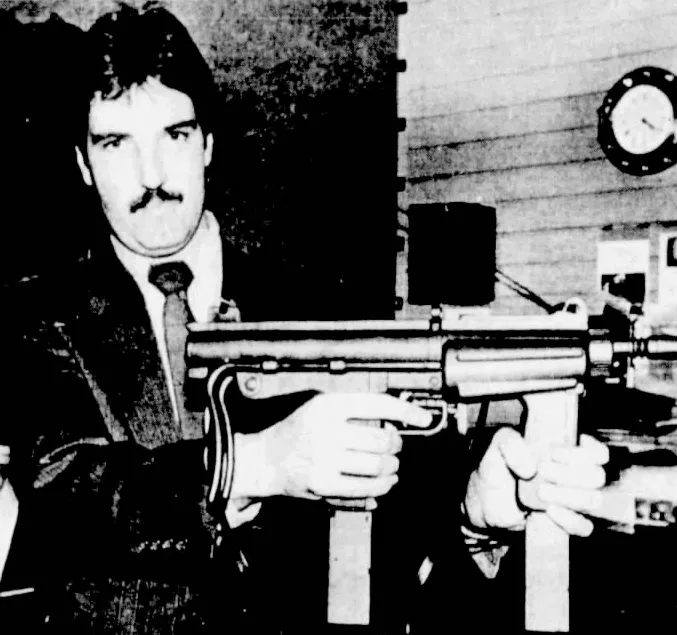
A Sharper Image salesman playing with toys for the camera, 1986
In a society with high levels of gun ownership, at a time when violent crime levels had been climbing for 25 years, that mistake could have disastrous consequences. And so it did. In truth, people toting play firearms had been getting shot well before Entertech came along. The victims were largely witless adults brandishing toy guns in robberies or disputes, only to find the other party was armed with the real thing: this actually happened to a teenage friend of my dad who pulled a squirt gun on a nightclub bouncer as a “joke”. But the casualties had also always included a few children. The main difference was that now more kids were running around with realistic toy guns because kids’ TV shows were inundated with commercials hawking them.
Living colors
So when a 13-year-old developmentally disabled boy in San Francisco was shot by police while playing with a toy gun, or a 19-year-old was killed by police during a game of Lazer Tag - not to mention countless near misses when police were called on kids with toy guns, from LA to Boston to West Virginia - the very conspicuous likes of Entertech found themselves in the figurative crosshairs.
Los Angeles became the first city government to ban realistic toy guns in 1987, with San Francisco following in 1988. Various cities and states joined in, with lawmakers considering federal-level bans. So the industry acted itself before it could be forced to. Led by retailers like Toys R Us, which banned realistic toy guns in 1988, toymakers shifted away from black and gray replicas of real firearms to big bulbous sci-fi contraptions in hi-vis shades of orange, green, and yellow.
Entertech tried to go along with the change, but now they were just one more motorized water gun in an ocean full of them. Their sales collapsed to essentially zero. After LJN was acquired by Acclaim Entertainment and converted into a video-game company, the Entertech trademark was allowed to lapse.
As you may have noticed, depending on where you live, realistic toy guns never went completely away in the US. Authorities from Mississippi to Massachusetts have recently warned of the dangers of toy guns being mistaken for the real thing. Last year, New York sued Walmart for shipping some realistic toy guns into the state, violating the state’s ban. But no doubt lives have been saved by the dayglo designs of toy guns over the last 40ish years.
Look, I get the appeal. 12-year-old Jason would have loved an Entertech Uzi. But he also would have loved an all-Big Mac diet, unlimited Little Debbies, and a 3 AM-noon sleep schedule. It’s a good sign that seeing little kids with toy Uzis seems just that unwholesome now.
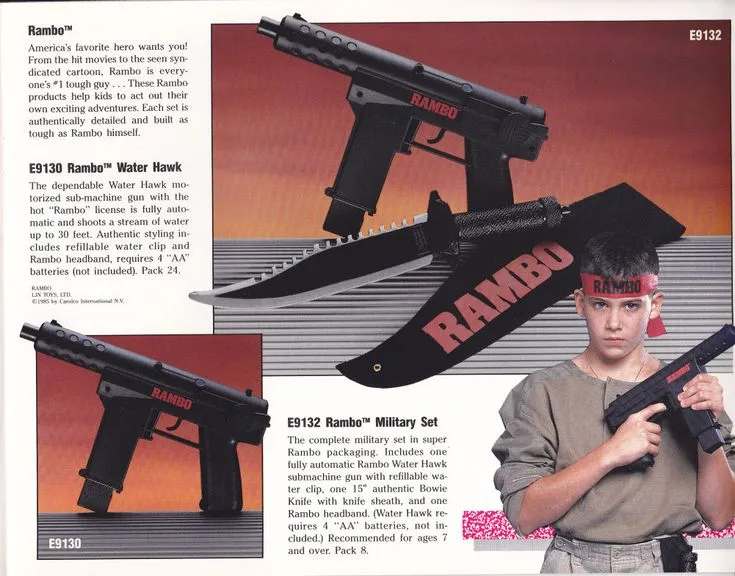
RAMBO: FIRST WATER, PART II
I have a specific memory, growing up, of a law getting passed that dictated that as of January 1985 throwing stars were going to be 18+ only. Throwing star sales went through the roof that December, 1984. What else were we going to throw around in the construction sites we trespassed in? What toys or clothes were banned, legally, parentally, or in schools during your childhood? Let’s hear about 'em in this week’s Shoddy Goods chat.
—Dave (and the rest of Meh)
Nobody would ever mistake these previous Shoddy Goods stories for a lethal weapon:
- Who came up with “holidays” like National Pickle Week?
- The poisoned fruit panic of 1989
- 50 years of the Big Gulp, the fountain soda that changed America
And if you like Shoddy Goods, don’t miss Jason’s new other newsletter, Gnomenclature. Every week he digs into the 178-year-history of Hammacher Schlemmer, America’s oddest retailer. It’s gonna get weird!
- 14 comments, 37 replies
- Comment
For the record I have not been able to find any evidence of this law, so it may have entirely been kids’ rumors. Or, hey, maybe it was completely made up by the throwing star store people to spur sales!
@dave Many such laws were state-by-state with wildly variable restrictions or the lack thereof. Customs has had regs about the import of weapons; I have no idea what may have been applied to throwing stars in that regard, but since I’ve seen them for sale in lots of places, it can’t have been all that much.
Far and away my biggest memory along these lines is Jarts.
Ginormous darts that you launched underhanded across the yard hoping to hit inside a round target when the point stuck in the dirt. What could go wrong??
@chienfou

@chienfou I recall, back when my age was a single digit, some family friend made me a rubber band gun. It was just a piece of wooden T&G board, roughly cut to the shape of a pistol, with a clothespin attached at one end that held/released a rubber band stretched across the top.

OK, fun for a while, but I got bored.
So I modified it with a piece of surgical tubing, anchored at one end and stretched to the clothespin “trigger”. Then a metal dart was set in the top groove. Pressing the clothespin “trigger” would launch the dart across the room and bury it in a target.
What could possibly go wrong?
@macromeh

@chienfou I remember those all too well! My brother hit me in the leg with one of the darts and it went completely in. That shit HURT and i still have a visible scar 34 years later…
@PurrpetualNap
nice to know you added to the count! (assuming you went to ER)
@chienfou Yup…Parents took me to the ED so they could take it out and I had to have a couple sutures. The crazy part is, a few days later when we were whining about being bored, they told us to go play it again but be more careful Also, 4 or 5 years following that, i was turning a flip on our trampoline to show off to my uncle and i misjudged and landed on my arm…broke both bones in my forearm and they were actually hanging out. Needless to say, it was surgery for that one.
@PurrpetualNap
Compound fractures are the worst… Did you end up with hardware?
@chienfou @PurrpetualNap
I’d love to see pictures of that one, or at least the X-rays! 🩻

At the time of the toy gun ban being passed in L.A., I was working in my first career at a boutique toy store. I was 19 or 20, and I thought the Entertech guns were very cool. The design & construction were good too, but the motor/pump system was unreliable (we got a lot of returns).
When the ban passed, I was almost crushed by the irony that our society will take immediate and drastic action to limit the sale of toy guns that are deemed dangerous, and will also do absolutely jack squat to limit the sale of actual guns.
@JohnnySocko
I think the danger was primarily in having them mistaken for real guns and getting your ass shot… not the gun itself being dangerous
Two things come to mind, both when I was in 7th-8th grade:
Clackers Ours were mad by casting resin in the shop class, so they were bigger and heavier than the ones in the video. If you got them going hard and fast enough you could shatter them into a million razor sharp shards Made great bolas, too
Nunchucks, of course…they were banned almost imediately, but lots and lots of Bruce Lee wannabees managed to whack ourselves in the fac, the back, and…other, more painful locations…
@thatappleiuser1 Nun Chucks were so illegal in Britain that you couldn’t even show them in movies. They had to cut out a whole section of the Kentucky Fried Movie to get it released there. Learned that useless piece of information yesterday.
@thatappleiuser1 I remember my friends have throwing stars from chinatown. You could make your own if you had decent tools and shop skillz.
Slap bracelets were banned pretty quickly at school. These days I see them made of plastic, but at the time I recall they were fairly hefty metal strips covered in a bit of fabric, and they could really smart- or worse, the edge would get exposed and you’d get sliced.
Plus they were annoying as hell when you have 20 kids all slapping them on their wrists at once.
@cainsley
Sounds like a stunt you would pull on a substitute teacher…
@cainsley @chienfou If I were a substitute teacher then I would have gotten a slap bracelet as well.
How about the metal molder from 90s where you melted metal pellets and pored it into modes to make di-cast objects?
Or those science and chemistry sets that gave you alcohol burners and real chemicals that could be pretty dangerous if mixed?
@braveit1 Gilbert U-238 Atomic Energy Laboratory
@braveit1 @mdiaz
Ah, yes. July was just not July without firecrackers, and the favorite of my older brothers was the M-80. In the 1950s and early 60s, fireworks stands had them and were happy to sell them to kids. My siblings used them to blow up stuff like cans and glass bottles. I remember one summer when they turned a cache of discarded plumbing into (what was effectively) pipe bombs. All great fun until they were banned.

@rockblossom Firecrackers were banned in Oregon (although available in bordering states, so plenty of them were around come the 4th of July).
But one 4th, my teen friends and I discovered that balloons, filled from an oxy/acetylene torch, made a dandy substitute. We played around with them for a while and then moved on to plastic trash bags and ultimately, full-sized garbage bags. (Pro tip - put a little water in the bag first, to discharge the static. Guess how we learned that…)
About 9PM, the sheriff called and said the neighbors had complained about setting off dynamite and we should stop. Fun times…
@rockblossom Before fireworks were banned in most of LA, we would go out the next day and look for firework duds. We found roman candles (already illegal) in the parks. We would gut the fireworks and end up with a little pile of “combustibles”. Many a plastic tank and numerous army men died of catastrophic wounds.
@cfg83 @rockblossom The Boy Scouts sold firecrackers in Detroit like the Girl Scouts sold cookies. You were supposed to receive a lesson in safety at time of purchase.
@mdiaz @rockblossom WOW! Boy Scouts and fireworks? Sign me up!
@mdiaz @rockblossom Behold the beauty of 1977 Freedom Fireworks in Los Angeles …
We used to put an m80 and a jumping jack in a little hug container. Fuse for the jumping jacks sticking out, light and throw it like a grenade. The plastic basically vaporized.
@ponagathos OMG, jumping jack shrapnel. If you had sharpened the tips, then they could have embedded themselves in tree trunks and such.
I am glad I didn’t invade your town. I never would have had a chance.
Maybe I will invade these guys instead. They seem like pushovers …
@cfg83 Oh no. Not the jacks from ball and jacks. That would have been insane. Jumping Jacks are a spinning firework. It shoots a flame out the side that changes colors and causes it to spin. Sometimes called flower fireworks maybe?
We used the jumping jacks to light the M80 in the container rather than lighting the M80 directly. Had enough firecrackers blow up in my hand to know I did not want that to happen with a M80. You see, we were actually trying to be “safe”.
@ponagathos Ohhhhkay, that’s much safer. We called them Ground Bloom Flowers …
@cfg83 Yes, those are the bigger ones. Jumping jacks were roughly the size of a firecracker and were packaged the same way. So, if you did not separate them you could set off ten or twelve at a time, just like a pack of firecrackers.
@ponagathos Ok, that is verrrrry interesting. I never saw those in LA in the 1970s. I think the ground bloom flowers were 2.5 to 3 inches long.
We had these big plastic robots that shot missiles and threw axes down the entire length of the hallway. We would heat up needles and stick them in the plastic missiles so we could shoot them into cardboard boxes.
@ponagathos
That’s brilliant!
@chienfou @ponagathos I agree!
The closest I got to that was a Snidley Whiplash spy pen that shot .75" long orange plastic “bullets”. I got it from the 99 cents store, so it must have been a safety recall. I carefully channeled a sewing pin through it so that it had a spiky tip. I don’t remember if it worked at all, but at least it existed.
This is the closest I could find to what I had as a kid in the 1970s …
The wood in mine was not stained. You could open the bolt and see a wooden bullet painted gold.
I could (and did) walk into a Federal building with that in order to buy candy in the gift shop.
Ahhhhh, those were the daze!
@cfg83
That red tipped barrel may have saved your ass!
@chienfou Nope, mine was clean. Nobody cared.
@cfg83 Those were still available at some national park visitor center stores when my wife and I did some travel in the '90s (with the orange barrel tips). Pretty sure they are gone now.
Saw this at the thrift shop the other day …
@cfg83 Wonder if anyone ever put a color scheme like that on a real weapon to sow a little confusion/hesitation into an adversary’s mind?
@phendrick Sounds like a Joker thing to do.
I had this in the 1970s …
Most of them didn’t come out very well, except for one little black scorpion masterpiece.
@cfg83 I had one of these:

Similar, except the goop was (more or less) candy. I actually had a little business selling candy spiders, worms and scorpions to classmates, until the teacher put a stop to it. Spoilsport…
@macromeh
@cfg83 @macromeh
I remember both of those. Specifically thingmaker as OG ‘creepy crawlers’…
On May 27, 1986, Black inventor and scientist Lonnie Johnson was awarded a patent for his water gun toy, which he originally simply called “Squirt Gun.” Johnson’s invention would eventually became the beloved water toy, the Super Soaker. He originally came up with the concept in 1982 while working as a nuclear engineer at the Jet Propulsion Laboratory in Pasadena, California. While brainstorming a heat pump for the Galileo mission to Jupiter, he hooked up a nozzle to his bathroom sink. When it accidentally shot water across his basement bathroom, he realized the design had potential for a water gun. Years later, he created a prototype for the idea using plexiglass, PVC pipes, and a two-liter soda bottle. He had his 7-year-old daughter Aneka try it out and it was a great success, but it wasn’t until 1989 that he found a production partner in the toy sector, Philadelphia-based Larami. The company manufactured the toy under the name Power Drencher and it sold 2 million units in 1991. Then Hasbro purchased Larami and renamed the toy the Super Soaker. The water gun sold over 250 million units and became so popular that it was inducted into the National Toy Hall of Fame in 2015. Johnson currently holds over 130 U.S. patents and is the author of several publications related to the field of spacecraft power systems. His Super Soaker water gun remains a summertime favorite for American kids today
@jkawaguchi
TIL… And I most definitely thank you for that!