The experimental fake meat of the '70s: Shoddy Goods 116
6
Hey hey, Jason Toon here with a new Shoddy Goods, the newsletter from Meh about consumer culture. There sure are a lot of vegetarian meat substitutes out there these days - but remember, trends are cyclical…
The early 1990s was not an easy time to be a vegetarian in America. It wasn’t just that there weren’t as many choices - it’s that it was hard to even figure out what your choices were. Whole articles in vegan ‘zines would be dedicated to breaking down what to look out for in food ingredient lists, and many a personal favorite food had to be sacrificed because of what seemed like capricious inclusions of gelatin or anchovy paste.
But when that same arbitrariness worked in your favor - when some random supermarket staple turned out to be accidentally vegetarian - the clouds parted. The most life-changing example of this, for me, was that Bac-Os, and other imitation bacon bits like Bac’n Pieces, were vegetarian. Oh, the veggie BLTs we had! Little did I know that they were the last survivor of what we can call the first wave of meat substitutes.
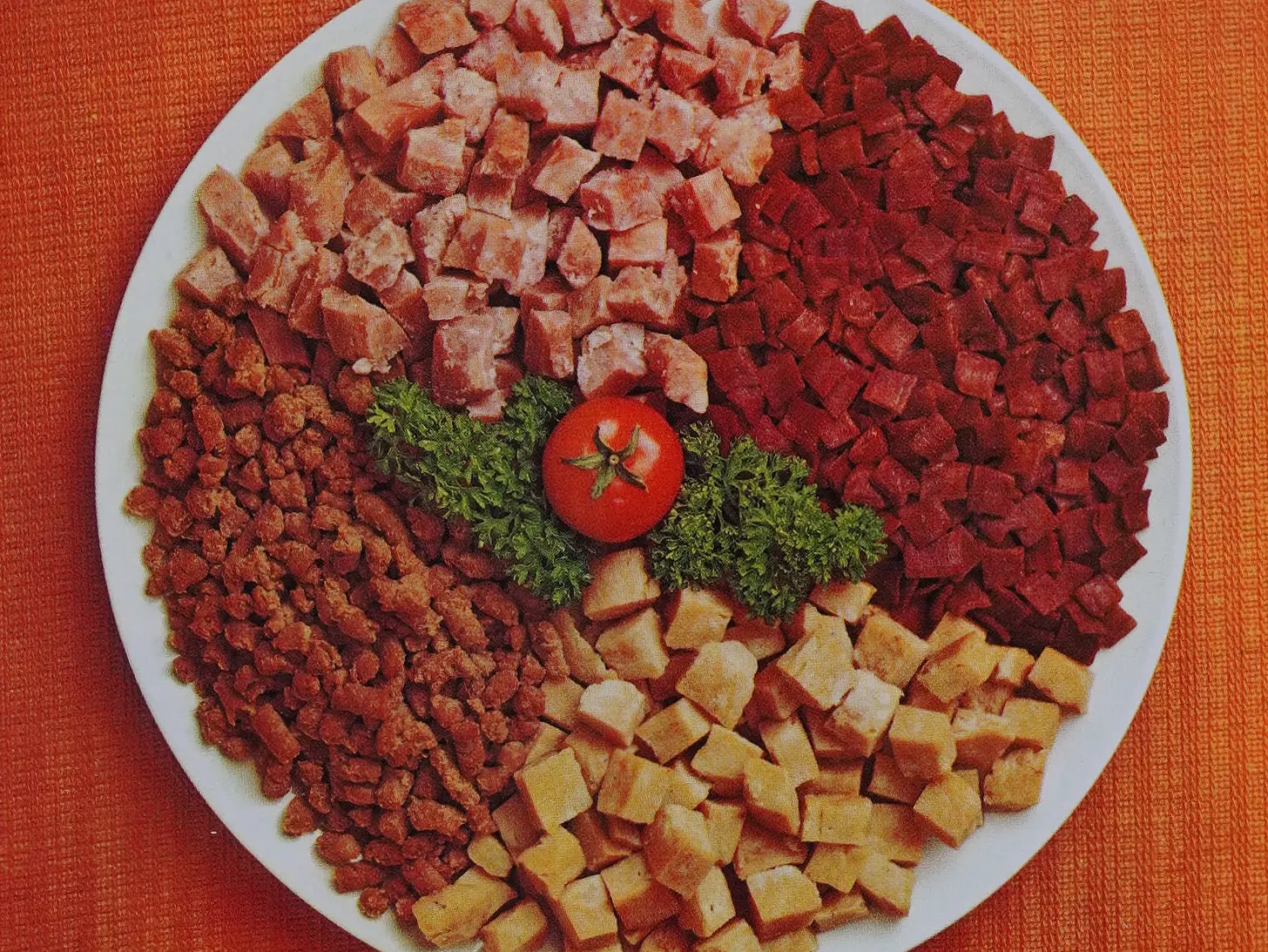
TVP stands for “Tastes Very Phuturistic”
“Food of the future”
“From a new plant at Cedar Rapids, lowa, BONTRAE textured vegetable protein foods will flow to restaurants, schools, hospitals, food processors and consumers,” enthused the 1970 General Mills annual report. A Betty Crocker magazine ad spelled out exactly what Bontrae was to readers of Woman’s Day and Better Homes and Gardens: “It’s General Mills’ name for a food of the future made with vegetable protein… Today you can buy it in crisp little Bac-Os - a unique product with a flavor like bacon. But some day you may be able to buy Bontrae tasting like chicken or beef or ham (and very much like them nutritionally).”
So far, so uninformative. What Bontrae really was was spun soy protein, a kind of textured vegetable protein (TVP) made from, you guessed it, soybeans. Scientists had been exploring how to make fibers out of the leftovers of the soybean oil processing since the 1920s, when Henry Ford thought it had promise as a source of fabric, or plastic, even debuting a soy-plastic car in 1941. But as food scientist Nadia Berenstein explains, it was the catering for that event that really pointed to the future, with the vegetarian Ford laying on a buffet of soy steaks, soy milk, and soybean coffee.
It would be decades before the most obvious drawbacks in soy “meat” were ironed out: the taste and its propensity for causing excessive farting. Then there was the related question of who would eat the stuff. The first commercial imitation meat made from spun soy protein, in the 1950s, was FriChik, a canned chicken substitute marketed to Seventh Day Adventists, whose religious faith required vegetarianism.
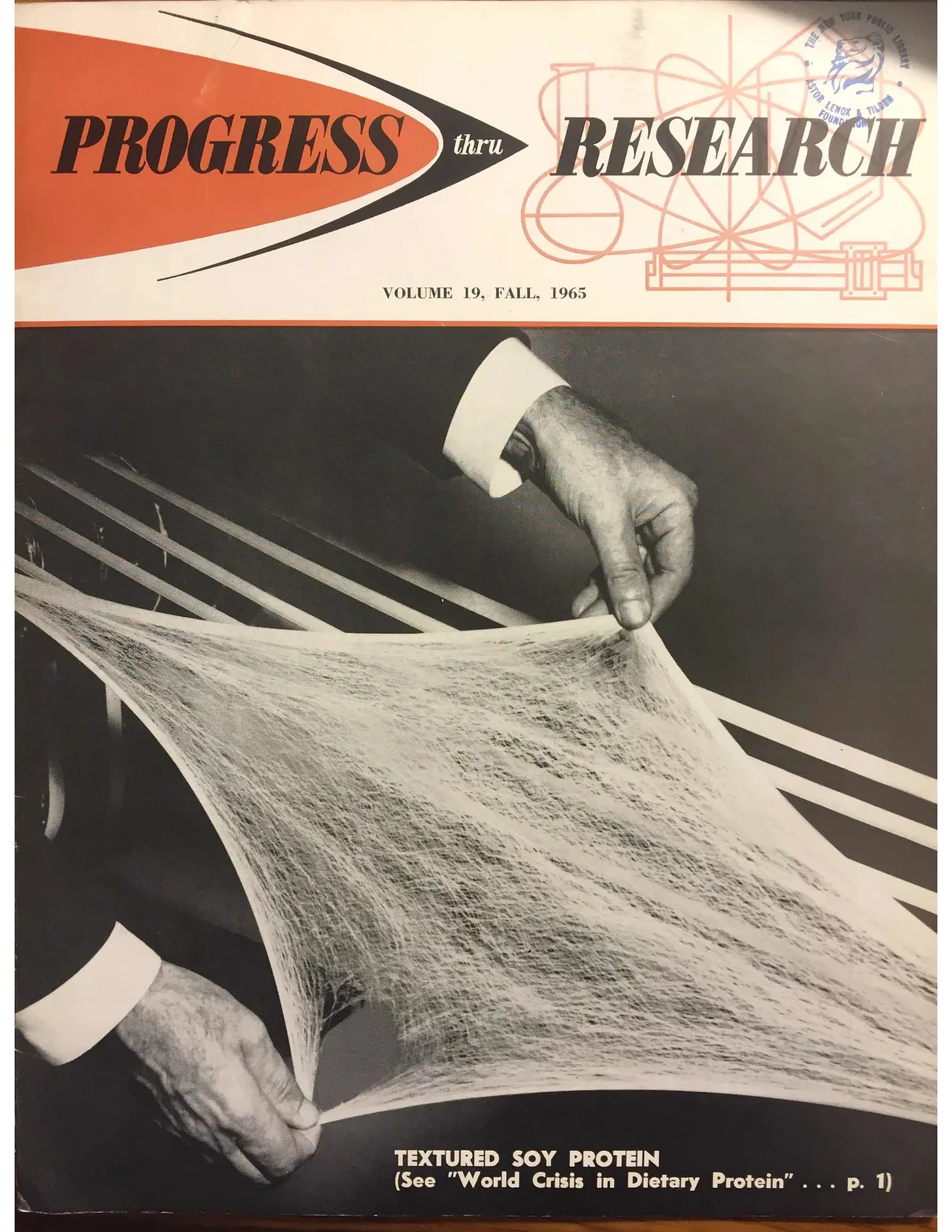
Mmm, who else is getting hungry?
But in a booming postwar America with a dozen burgers on every grill, there was about as much demand for vegetarian meat as there was for Bolshevism. Besides, Americans still remembered when soy meal was used as a “meat extender” to bulk up such World War II delicacies as “victory sausages”, and those memories were not fond.
“Picked by a computer”
It would take a convergence of economic, ecological, and health anxieties to make companies like General Mills consider the potential of soy protein. Paul and Anne Ehrlich’s book The Population Bomb was published in 1968, declaring “In the 1970s hundreds of millions of people will starve to death.” Its nightmare scenarios of global famine quickly became conventional wisdom. A less alarmist school of thought, embodied in another bestseller, 1971’s Diet for a Small Planet by Frances Moore Lappé, argued that the planet produced more than enough food to feed everyone; the issue was that too much of it was used to feed animals to produce meat.
Either way, steadily rising meat prices seemed to confirm that the future of food would be increasingly meatless. By 1969, General Mills was ready to meet the trend.
They gave their non-meat the non-name “Bontrae”. General Mills president James MacFarland told the hometown Cedar Rapids Gazette that Bontrae didn’t mean anything in particular: “It was picked by a computer.” More likely, what it meant was that he hoped the meat industry (which General Mills was part of) wouldn’t see it as competition, and consumers wouldn’t associate it with bad memories of victory sausage.
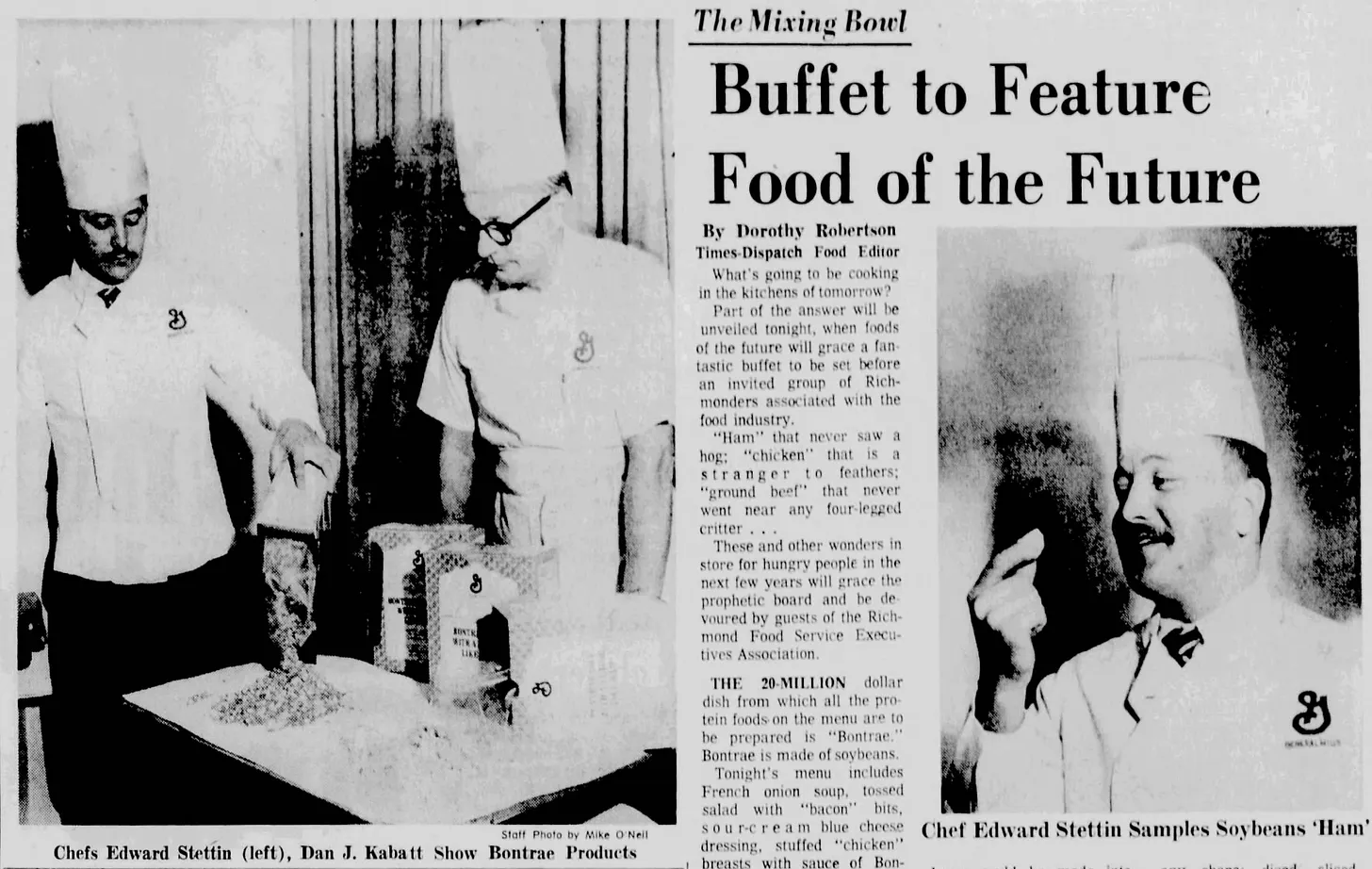
I’m comin’ for ya, Boyardee
Then they took the “food of the future” on a national coming-out tour of publicity luncheons. The Cedar Rapids event featured such dishes as “a seafood dish called Coquilles Saint Jacques and Bontrea alla Barbara, containing chunks of ham made from soy.” In Richmond, Virginia, General Mills experimental chef Edward Stettin told the Times-Dispatch “General Mills has been experimenting with this for 20 years,” predicting that the “ham”, “chicken” and “meat loaf” served at the event would be in supermarkets within two years.
The bacon bits already were. At first, Bac-Os made no secret of its Bontrae connection. The aforementioned Betty Crocker ad devoted as much space to Bontrae as to Bac-Os themselves. The Bac-Os jar initially bore the description “Crispy Bontrae bits with a flavor like bacon”. The product was clearly meant to introduce the public to this “new kind of food”, as General Mills was hoping the US Department of Agriculture would classify Bontrae, neither flesh nor flora. (Its petition was denied.)
Bacon bits made a lot of sense as the first mass-market Bontrae product. So much of the appeal is in the texture, and neither that nor the smoky flavor was difficult to mimic. It was also an embellishment to another dish, not a main dish itself, so nobody would really be tasting it in isolation. A small jar of shelf-stable Bac-Os was a low-risk purchase for a curious homemaker. Initial sales of Bac-Os were so strong that General Mills introduced Pepr-Os and Saus-Os, spun soy protein takes on pepperoni and sausage chunks. If Bac-Os were any indication, America was hungry for the rest of the Bontrae line.
“Just like the Army”
As you may have noticed, it didn’t work out that way. In 1972, just a little behind Chef Stettin’s prediction, the first Bontrae diced chicken and ham started to appear at butcher counters, after first being rolled out to institutional kitchens at facilities like schools. In many of those cases, Bontrae was used as an additive in meat products, helping bring the phrase “mystery meat” into the vocabulary.
Hopes were high - “you can cut your protein cost by 25 percent and have a food that is lower in bacteria count,” chirped a newspaper advertorial - but sales and reviews were mixed. A Boston Globe reporter was initially fooled into thinking the fake chicken was real turkey before noticing “a potato-like taste.” Some of the University of Massachusetts students he spoke to thought it was OK, but others thought it was “a little powdery” or, in the words of a school administrator, “just like the Army”. Turned out replicating the complex experience of eating fresh meat - the overall flavor, the texture and bite, the way it cooked, everything - was more complicated than mimicking the smoky crunch of bacon bits.
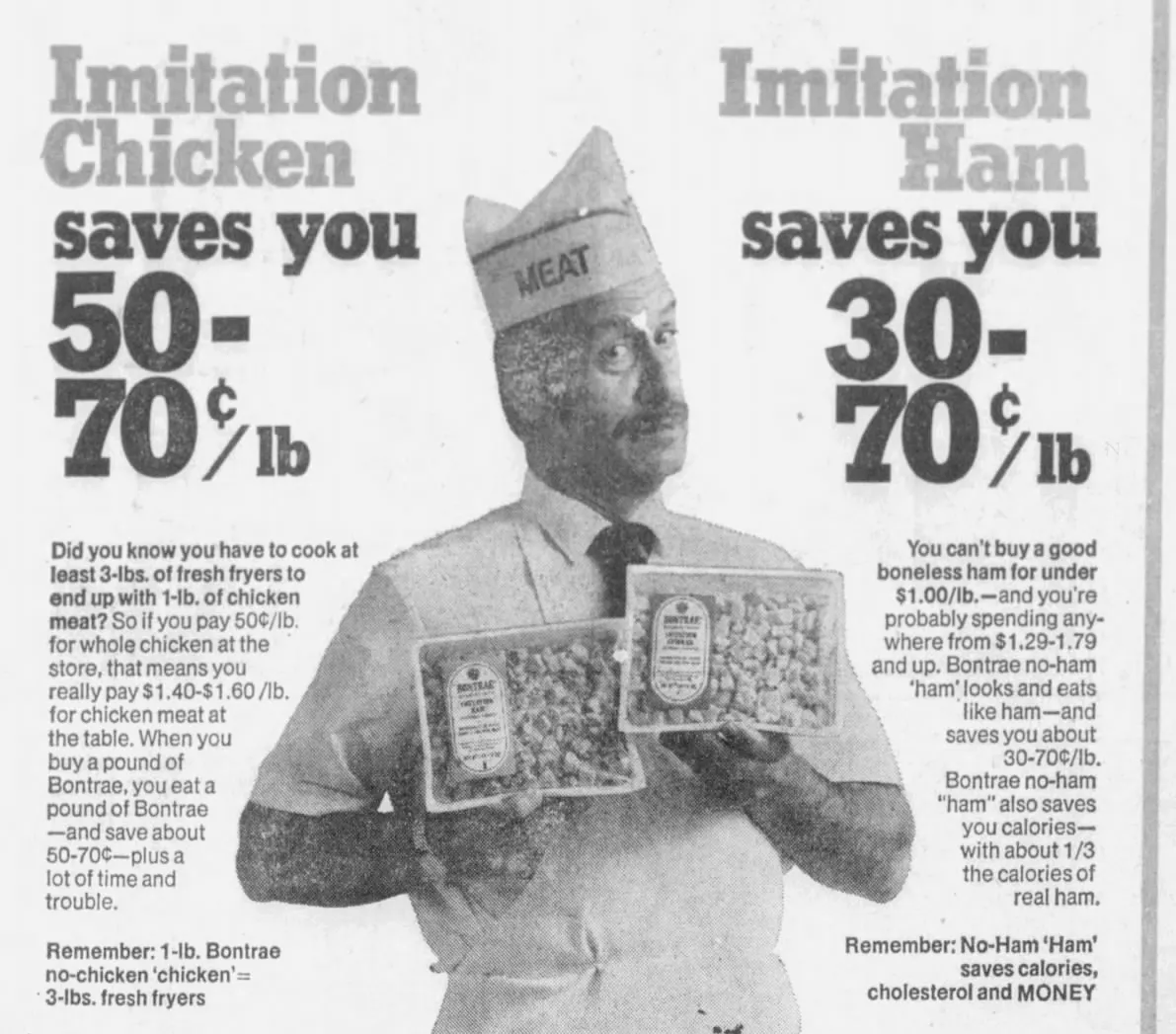
No, you can’t have my cool MEAT hat
As Bontrae stubbornly refused to fly off the shelves, any mention of the “new food” was quietly removed from Bac-Os packaging and advertising. By 1975 General Mills was running a campaign called “the Bontrae Bribe”, offering customers a $1 rebate on any fresh Bontrae purchase even if the customer hadn’t spent that much to begin with. “Why would we pay you a $1.00 to try our under-a-$1.00 product? Because we think once you sink your teeth into no-chicken ‘chicken’ and no-ham ‘ham’ you’ll be hooked - on saving money, saving time, saving cholesterol - and besides, we’ll bet you can’t taste the difference.”
Like their big investment in Bontrae, that was a bet General Mills would lose. It would take more than a dollar to get 1970s America to swap its meat for sculpted strands of soy protein. As the very title of the industrial-cannibalism dystopia Soylent Green (1973) shows, there was a deep vein of public mistrust toward the idea of futuristic engineered foods. General Mills didn’t do itself any favors by using terms like “textured vegetable protein” and “meat analogs” in the media.
That was Bontrae’s last stand. In 1976 General Mills surrendered and sold the trademark, converting the Cedar Rapids plant to make Wheaties instead. But Bac-Os would remain a staple of home salad bars and vegetarian BLTs until 2016, and imitators continue to this day: the last remnants of an idea that was several decades ahead of its time. My teenage vegetarian self appreciated it.
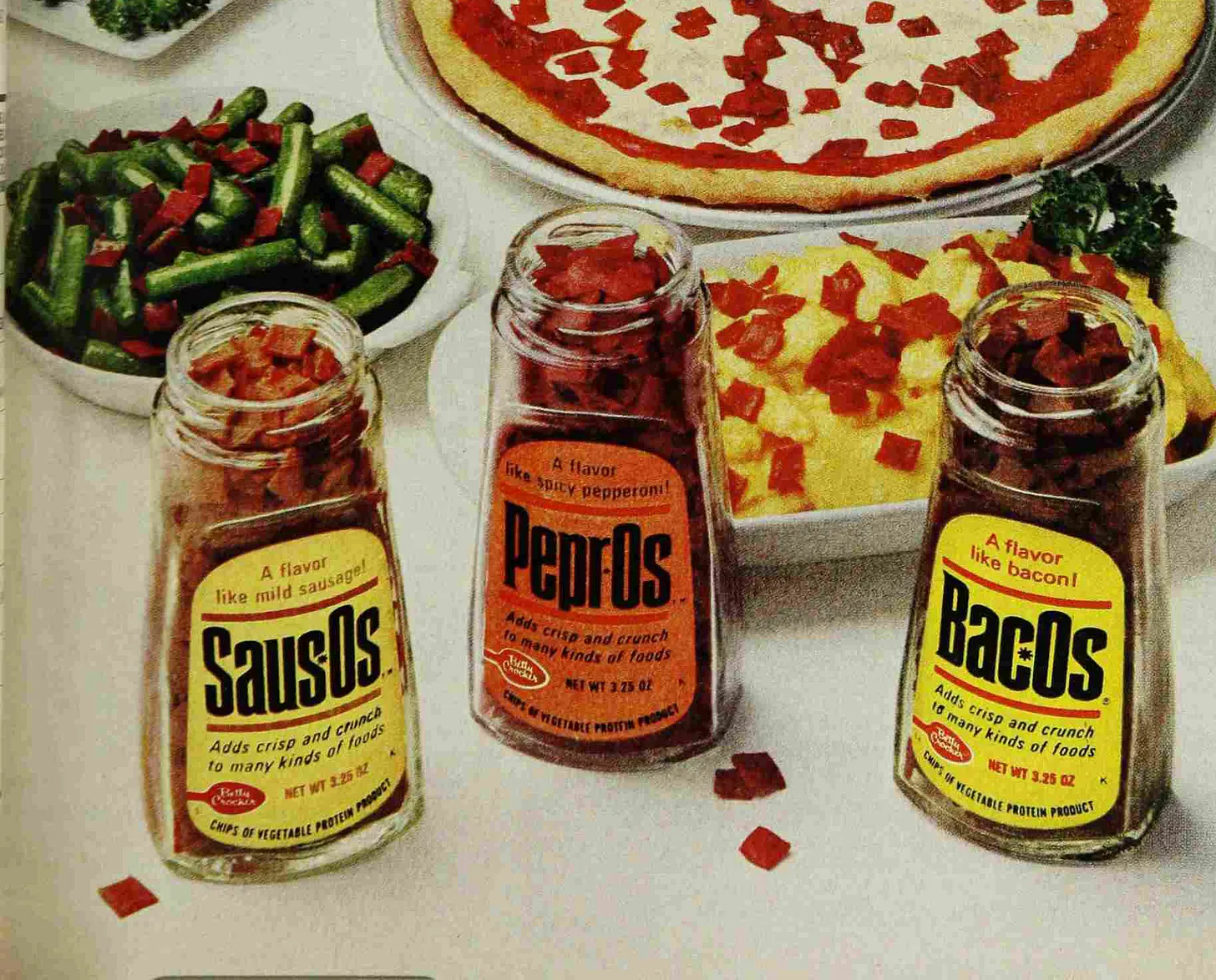
This is why historians call the 1970s “the Age of Crunchy Salad Bits”
My habit of scanning the ingredient lists started when my mom said I pick any cereal I wanted, as long as sugar wasn’t in the first two ingredients. It’s absurd how hard that is. But it’s continued on through my vegetarian years and into hunting for food allergy issues. Have you lived blissfully unaware of the ingredients lists on everything in your pantry? Or do you have your own reasons you’re checking those side panels? Let’s hear about ’em in this week’s Shoddy Goods chat.
—Dave (and the rest of Meh)
These previous Shoddy Goods stories contain no more than 30% spun soy protein:
- The DIY origins of the salad bar
- Is Cheez Kisses the grossest name for a snack food ever?
- Speef, Treet, Wham, and other pretenders to Spam’s throne
And if you like Shoddy Goods, don’t miss Jason’s new other newsletter, Gnomenclature. Every week he digs into the 178-year-history of Hammacher Schlemmer, America’s oddest retailer. It gets weird!
- 11 comments, 29 replies
- Comment
I’ve been doing that for a very long time. My first ex and I were married in 1981, and we used to make a game of looking up the “it sound like it came from a lab” stuff on ingredient lists to see what they really were. I’ve never stopped. One of the first things we dropped as a result was Mountain Dew; I don’t recall if it was because of PEG or brominated vegetable oil, but both of them ended up on the “nope” list. There is an absolutely stark difference between Fanta Orange in the US (contains no OJ) and the same named product in the UK and Europe (contains OJ and isn’t dark orange), by way of just one example of how what we are sold is Just Wrong. The food in the UK and in New Zealand is just better than it is here.
@werehatrack
I’ve been drinking Dew since the mid-eighties because coffee makes me hurl, colas tear up my stomach, and I can only drink so much water, flavored or otherwise. What sold me on it besides liking the taste was that the 2nd listed ingredient is concentrated orange juice [after carbonated water]. At the time, the lower listed ingredients didn’t interest me as much.
I just found out that the new black tops that they changed to on Diet Mtn. Dew is to indicate that they are now sugar-free.
The PEG has been absent for more than a decade, but brominated vegetable oil was only quietly pulled in the later 90’s or 2020.
Interestingly, the interferon that my life depends on [injected bi-weekly] is bound to PEG so that it has a longer duration- go figure.
As for TVP, I have always been a fan of the Morningstar Farms meat substitute products, first the breakfast sausage analogues, then the garden burgers, and now the chik’n patties. We don’t like the “Better than” products as much…
I believe you about the relative food qualities between the US and other more consumer-friendly countries.
@PhysAssist @werehatrack
There are various PEGs for various reasons. Miralax is PEG-350 for instance.
@chienfou @werehatrack
So noted.
My interferon has PEG 20K.
@PhysAssist @werehatrack
Exactly
I buy my MSG now in bulk because “they” have removed it from so many delicious things.
@therealjrn They’re just hiding it by using “maltodextrin” or “celery seed” or any of a number of other glutamate-rich things instead. It’s still there, they’re just lying about it. But they’re cheaping out on everything else, and glutamates can’t enhance what isn’t there to begin with. That’s part of why we’ve been trained to think of “excessively sweet” as “good”; sugar is cheap.
@therealjrn I do the same! I use MSG in many dishes (1/3 the sodium of table salt for those that don’t know) sometimes as a supplement, and sometimes as a replacement. I found it to be more equitable than buying the little 4.5 ounce Accent bottles.
@therealjrn @werehatrack
Also:
"Hidden Names For MSG And Free Glutamic Acid:
Names of ingredients that always contain processed free glutamic acid.
Glutamic Acid (E 620)2
Glutamate (E 620)
Monosodium Glutamate (E 621)
Monopotassium Glutamate (E 622)
Calcium Glutamate (E 623)
Monoammonium Glutamate (E 624)
Magnesium Glutamate (E 625)
Natrium Glutamate
Yeast Extract
Anything hydrolyzed
Any hydrolyzed protein
Calcium Caseinate
Sodium Caseinate
Yeast Food
Yeast Nutrient
Autolyzed Yeast
Gelatin
Textured Protein
Soy Protein Isolate
Whey Protein Isolate
Anything :protein
Vetsin
Ajinomoto"
@therealjrn @tohar1 define “bulk” MSG.
https://www.amazon.com/dp/B00I0M99MU?
Yeah that’s maybe half the price of accent but if you’re buying more than a pound lol. I wonder how it’s getting used. Takes a while to go through a bottle of accent for me.
@therealjrn @unksol This is the one that I buy. Bulk MSG
I use 2-3 of these big containers per year. (I do a LOT of cooking!) It saves me about .38 per ounce buying it this way vs. the 4.5 ounce Ac’cent package, but certainly give the small ones a try if you’ve never.
@therealjrn @tohar1 that would fit in my spice line up I think. But would take me years to use. I cook a big pot for me and leftovers. I don’t feed the neighborhood.
Even with a family that feels like a lot. But whatever floats your boat.
Definitely agree people with negative conotations about MSG and asian food cause of the racist Chinese syndrome stuff. Just total horse shit.
Not everyone picks up on glutimates but definitely try some
Funny how everyone used to be so afraid of the word “sugar” and now we are finding issues with its replacements like high fructose corn syrup. Just go back to natural ingredients.
@jsh139
Too expensive for laboratory/warehouse food manufacturing according to corporate America.
@jsh139 I don’t think that’s accurate. Everyone knows what HFCS is which one just frutose and succrose. There’s nothing better about “sugar”.
Really should be avoiding lots of added sugar or any type in the first place which is right on the nutrition label. Not really an ingredient issue to me
Relatively new to “fake” meat (only about 4 years into my plant-based journey) so I didn’t even realize that Bac-O’s weren’t dehydrated bacon!! This was a fun article though, so well done Jason Toon! (PS: You can count me in as a proponent on TVP! I use it at least weekly.)
I usually make a lot of our food, so I know what goes into it. Being a total flake, I even mill my own flour from organic wheat for breads and baked goods.
@krez56 My stepdaughter has problems with modern wheat, so we’re going to be milling heritage-variety flour for her. Finding the grain is tricky; the yield per acre is about a third of the superdwarf, so only a few special-interest farms grow it at any scale.
@werehatrack And the shipping can double or triple the cost. I’m not in a wheat-growing state, so the grain gets more and more expensive. If you have a local organic grocery that has bulk bins, they will sometimes put in a bulk order for you to tag onto their orders.
Otherwise, check out Farmer’s Storehouse, Living Sky Grains, and https://www.ancientgrains.com. Good luck!
@krez56 @werehatrack
Curiously, newer super high yield varieties of wheat were not created for cost savings. I think.
There were created (or so I have read) as an anti communist measure, paid for by the IS govt. (perhaps often thru USAID)
I haven’t done my own looking into this just read a few pop books and it’s been a while so maybe I don’t remember these books in detail
Basically what I remember reading is that the US government paid enormous grain farms, sometimes created from scratch, to experiment with massive genetic alterations and breeding programs to increase yield dramatically
The reason was that after World War II was so much of the world’s agriculture and economy were destroyed that the US government feared there would be massive famine around the world, and that would render the poorer populations susceptible to communism and to revolution
So on these farms, many of which I believe were at altitude in Mexico these massive experiments were done, with no attention to anything but yield and calories
So those old photographs and art we see of wheat harvesting in the field with grain growing almost as tall as a person are all pretty much pre-this govt program
Now knee or thigh high at best and has extremely heavy yield and when it’s ready for harvest, it’s so heavy that the stalks have to be short or they would break from the weight
The program was so successful in upping the yield, and the government did various guaranteed buy programs for farms
That farmers essentially had to abandon the older lower yield wheat varieties in order to keep their acreage economically viable
After a couple of decades so much production in North America shifted to the new varieties when somebody wanted to even study the older varieties or their health differentials, it was a bit problems tic to source the older varieties of wheat for study.
Supposedly all the US baby boomers pretty much grew up on the old wheat at least for their first 15 years and maybe longer depending on birth year.
And anyone born after 1970 to 1975 grew up on mostly new wheat
I don’t know that there’s ever been a big rigorous study about health or celiac disease or gluten intolerance effects of old vs new wheat and genetic changes in wheat. .
Furthermore, the genetic changes in wheat have keep going since shortly after WWII.
There are specialty wheat sources where one can buy some of the older varieties of wheat, but I don’t know what they are.
Possibly Deaf Smith sells this? IDK.
@f00l @krez56 @werehatrack I hear about this place because it’s local, but haven’t been there. (Too many other projects to do any serious baking.)
https://cairnspring.com/
On this side of the mountains, farmers grow wheat mainly for crop rotation purposes. So natural fit for boutique grains.
@f00l @walarney @werehatrack They don’t seem to sell grain - just what has already been milled into flour. I love the fresh taste and faint nuttiness of just-milled flour, so I buy from places that sell grain.
@f00l @krez56 @werehatrack Sounds nice. Started looking at a book about home milling while browsing a bookstore one time and almost got sucked into yet another hobby.
While looking for that link, found a store in AZ selling a wheat berry blend from WA where i live. Don’t want to seem like i’m pushing it, but: https://oatmanfarms.com/products/wheat-berries-skagit-blend
There was a great TVP product called “Jumbo Grills” back in the day, it came in the form of a big gross dry hard biscuit and some powder; you’d boil it, mix the powder as a gravy, then pan-fry it in the gravy and it turned out just really good for a sandwich, a chewy moist airy thing with a lot of flavor thanks to the gravy. That airiness is hard to replicate with seitan. I’m not aware of anything like it now - you can get some medium-sized TVP “curls” that make for the same kind of texture, and if you cook them up in stock they’re pretty good, but it’s not the same when it’s not one big fakesteak.
I couldn’t even find any webpage mentioning them, but google’s AI somehow knows about them!
(Sosmix is also a sadly missing product these days.)
Alas, I am one of those vegetarian weirdos.
Although I’ve been scanning ingredient lists as far back as I can remember.
Interesting note: young jackfruit is very close to meat in texture if prepared correctly.
I’ve had a vegan pulled pork and a pork tostada, both of which were 1:1 like the real thing.
Sorcery I swear.
I was that weird kid who didn’t eat the half-sugar (or worse) breakfast cereals; my faves were Cheerios and Shredded Wheat.
@werehatrack I like those, but nothing wrong with some coco pebbles now and then. The actual nabisco shredded wheat hockey puck size things instead of “mini” wheats.
Rasin, date, and Walnut oatmeal. There’s so much sugar in the other ones… although I just make plain oatmeal with raisins/cinnamon/vanilla now.
Grapenuts.
Grandparents used to have this kinda of cereal… Bucket… they just mixed all the non sugar cereal together in which was interesting.
@werehatrack And 60+ years ago I was adding a spoonful of sugar to my Sugar Frosted Flakes.
@unksol I add rice protein powder, dried blackcurrants, pie spice, vanilla, and a little sweetener to oatmeal. And I use milk instead of water. When I run out of black currants, I’ll use dried unsweetened cranberries or diced dried apricots or peaches. Sometimes I combine the dried fruits. If I remember to do it, I’ll put them together the night before and leave them in the refrigerator to soak until breakfast. 7 minutes in the microwave on 40%, and 5 minutes of rest produces a very reliable result.
@werehatrack nice. I’m just boiling water. Need to up my oatmeal game I guess lol
Having Crohn’s disease (an autoimmune disorder where your body mistakenly attacks the intestinal lining) for the past 22 years, I am an inveterate label reader. While theories abound, some believe that various weird food chemicals with unpronounceable names affect the permeability of the gut lining, triggering an uncontrolled inflammatory response. I avoid foods with ingredients that I don’t have in my kitchen, including various “texturizers,” preservatives, enhancers, and sweeteners. I lump these chemicals into a category I call Polyethylsqait-hydrophibilide…
@MrNews One acquaintance who was initially diagnosed with Crohn’s later found out that it was actually an allergy to wheat gluten. This is just an observation, if it hasn’t already been checked, you might want to see if that’s relevant.
@werehatrack Thanks. Any alleged gastroenterologist diagnosing IBD without ruling out several other causes of inflammation is clearly incompetent. After 14 years on medical & scientific committees, I may actually know more than some of these quacks!
My wife has a litany of food allergies, and I do the majority of the shopping, so I’m constantly reading ingredient labels. Do you know how hard it is find packaged products that don’t contain tomato, coconut, or avocado? She makes her own beef stock because store-bought stock and broth contain tomato paste. We have to skip snacks that are made with avocado or coconut oil, or contain tomato powder, and it seems like there are so many prepared foods that contain tomatoes, or tomato paste, or ketchup. Ketchup is even used at a lot of restaurants to thicken sauces.
@Mostly_Harmless Someone else is allergic to tomatoes! I’m not go-into-anaphylactic-shock allergic, but my face gets really messed up if I eat any tomato-containing foods. Even if it is far down on the list of ingredients. And inflammation begets inflammation, so it can take months before my skin clears up.
@krez56 My wife’s reaction to tomatoes is almost immediate; even if it’s just a tiny bit of cross-contamination. Her throat starts to close up, to the point where she can’t swallow her food, but she can still breathe mostly through her nose and somewhat through her mouth. Her body also starts to produce a lot of mucus, probably as a way to help get rid of the allergen. She has an epi-pen but hasn’t had to use it yet. It takes her about a week to recover from an attack.
@Mostly_Harmless I have a friend who discovered that she is allergic to onions and garlic. Try finding prepared foods that don’t have those ingredients.
@werehatrack Oh, man…I feel for your friend!
My grandfather worked for General Mills in the food research division. He once told me he came up with a soy based crab replacement, but the world wasn’t ready for it. I suspect it was very much like the sea-legs you find today. A lot of his work was based on finding a way to get nutrient rich foods to malnourished parts of the world. He traveled quite a bit for them in the 40’s and 50’s, Japan, Afghanistan and Mexico are some of the places I know he visited doing research.
@Pitmonkey I forgot my real reason for posting, got side tracked by Grandpa. We have an exchange student and she asked for something called Konjac Snacks. I actually found it, Moishine snacks made from konjac power (a root vegetable starch), this one in particular is shaped like little squishy squid tentacles in a spicy oily sauce. The next time I visited the Asian market, I found one that was like a little square of beef, made from wheat gluten, in the same spicy oily sauce, and it was actually pretty good! I ended up eating most of the pack, then I tried the squid one again and it was, still odd, but pretty good. I guess these things are the most popular snack with kids in China these days. Something you might want to check out if you are into the whole plant diet thing. I don’t know if they qualify as vegan though.