For whom the beep tolls: Shoddy Goods 065
2
Beep! Jason Toon calling with another Shoddy Goods, the newsletter from Meh about consumer culture. Every time a spam text horns in on your attention, every time somebody from work interrupts your vacation, you can trace it back to that humble bygone companion of doctor and drug-dealer alike…
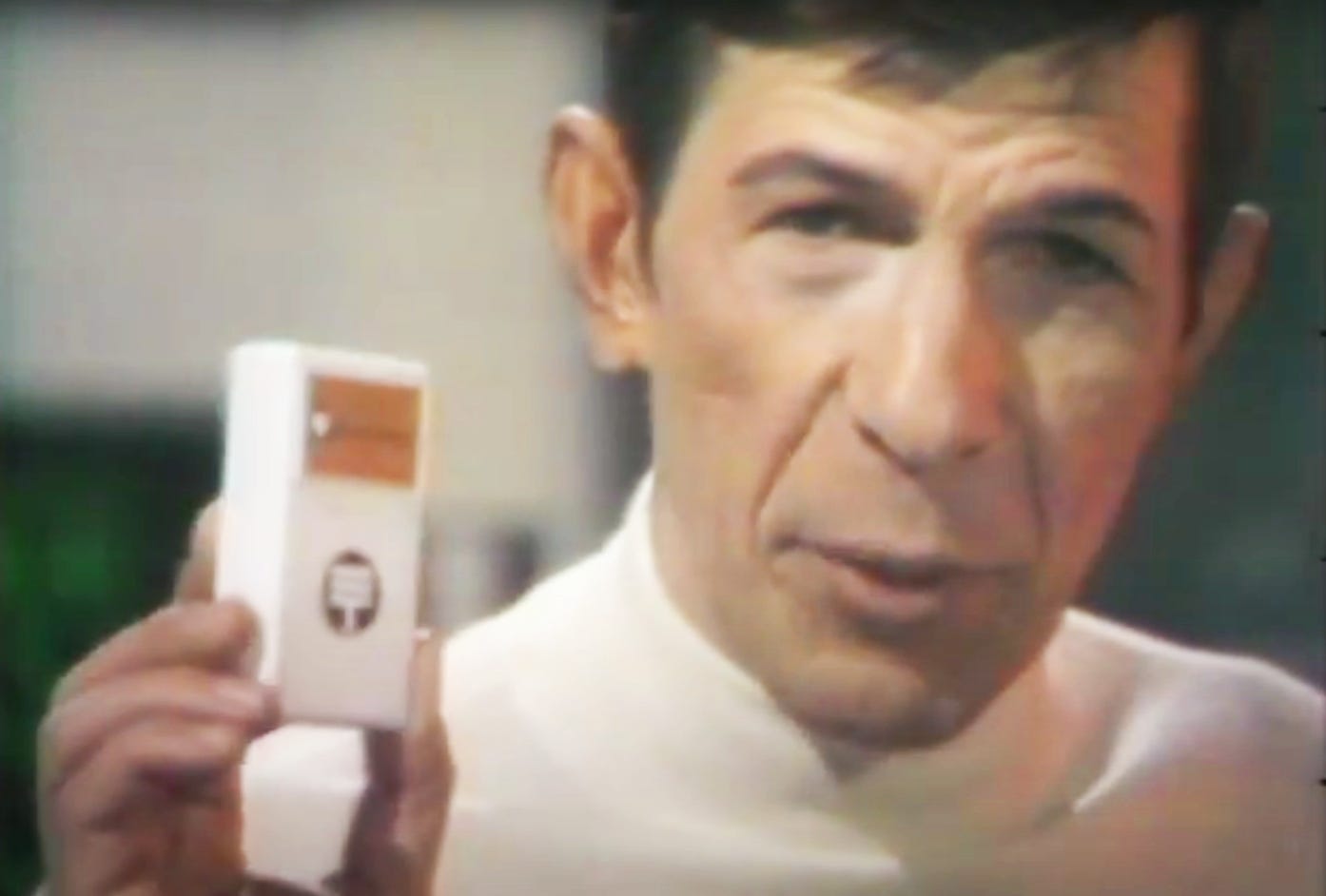
“Beep me up, Scotty”? “In search of a call back”? Writing captions is hard
What technology makes possible often becomes mandatory. So it went with mobile phones. In the historical blink of an eye, liberation from the landline became the tyranny of 24/7 reachability. The assumption that you’ll always be in touch has become so pervasive, digital detox retreats charge thousands of dollars to keep you out of touch. And governments are passing laws ensuring workers have a “right to disconnect.”
You’ve heard this complaint before. But I think the magnitude of the shift is actually under-recognized. Whatever its positive and negative aspects, the ability (and thus expectation) to be constantly available to anyone who demands your attention, wherever you are, is a pretty huge freakin’ deal for ol’ Homo sapiens. I wanted to go back to the very beginning and see if we saw this coming, if we had any idea how much this would change the fundamental shape of daily life.
And to do that, I had to go back to a time before the mobile phone era. I had to look at what people said about the very first technology that brought constant connectivity to the masses: the pager.
1983: the year beepers broke
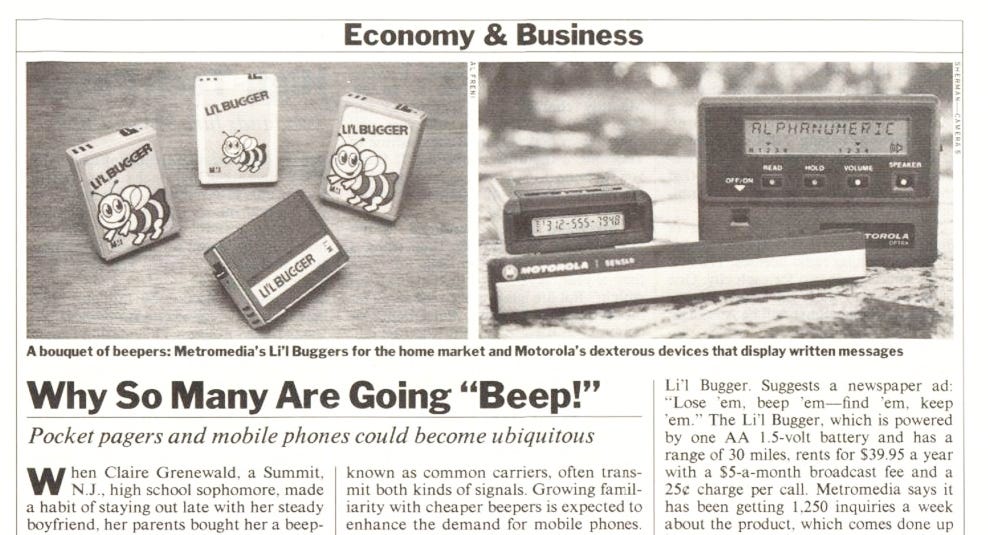
Time magazine’s crystal ball was working that day
OK, so pagers have been a punchline for at least twenty years. But for the twenty years before that, they were the shit. At their peak in the late ‘90s, pagers generated $4 billion in annual revenue in the US alone (more like $8 billion in today’s dollars), with some 45 million Americans using them. While they’d been around as expensive specialist items since the 1950s, associated mostly with doctors, beepers hit the consumer mainstream in a big way in 1983.
“Beepers seem destined to become the most popular portable electronic devices since the Sony Walkman,” wrote Time magazine in its April 11, 1983 issue. By that year, beeper usage had grown to 2.5 million Americans from 1.1 million in 1980, and just 50,000 in 1970.
The boom was driven by new, cheaper beepers, with Radio Shack’s basic $99.95 model the first to break the under-$100 barrier. The advertising battle was fierce. Metromedia went for the family dollar with their basic $150 beeper, the Li’l Bugger, complete with colorful bee packaging and a lovable tyke with a sideways ballcap hawking them in commercials. EdTel emphasized the futuristic vibe with none other than Leonard Nimoy.
Anecdotally, this is about the time I first became aware of beepers. One day, in the car with a friend of my mom’s who worked for some kind of social service agency, their beeper went off and we had to pull over and find a payphone. It did indeed have a whiff of Star Trek about it.
The first consumer pagers with alphanumeric LCD displays were just coming out and still astronomically expensive. Mobile phones were more expensive still, and there were waiting lists to use limited bandwidth. Literally all most of these early mobile devices did was beep. But at the time, those beeps were techno-wizardry enough.
“You would not believe the range of people who have beepers,” Margaret Eubank Gerdts of local paging providers Metrocall told the Richmond Times-Dispatch in the paper’s September 29, 1983 edition. “The range runs from your plumber all the way up to your governor… I’ve heard some people give one number to their wife and one to their girlfriend.”

Look, Ma, no escape from the global cybersurveillance hydra!
But AT WHAT COST?!?
In the gee-whiz tone of most of the 1983 media coverage, it’s hard to detect a sense that a social Rubicon had been crossed. The most common negative reaction was a kind of curmudgeonly annoyance.
“So-called ‘progress’ is bringing us another technological innovation which is sure to be more trouble than it’s worth,” wrote columnist Mark O’Brien in the Pensacola News-Journal. “I’m talking about the lastest model of personal pagers, those obnoxious little beepers with a knack for sounding off at the most inconvenient of times.”
But some journalists realized they should at least try to find somebody with a critical view of the new fad. So a few voices pop up that foreshadow what we know now about the hazards of constant connectivity.
“Some experts worry about the strain of staying in touch 24 hours a day,” wrote Alexander L. Taylor III in Time. “Marilyn Komechak, a Fort Worth psychologist who has clinically studied stress, believes that prolonged use of beepers produces anxiety and probably high blood pressure. ‘I have never seen anyone respond to a beep with a smile or a less than strident comment,’ she says.”
The San Francisco Chronicle (October 19, 1983) quoted an advertising executive: “Research shows that people think of pagers - if they think of them at all - as a leash, a way for the office to interfere and keep tabs on your life.”
In the same story, a different ad exec says, “Paging’s like long distance. That was once used primarily on an occasional or emergency basis; today, you call California to say hello or talk about the weather. It’s this promiscuous use that we’re convinced exists for paging. We’re going to promote it as an everyday extension of the phone, a natural way to stay in touch.”
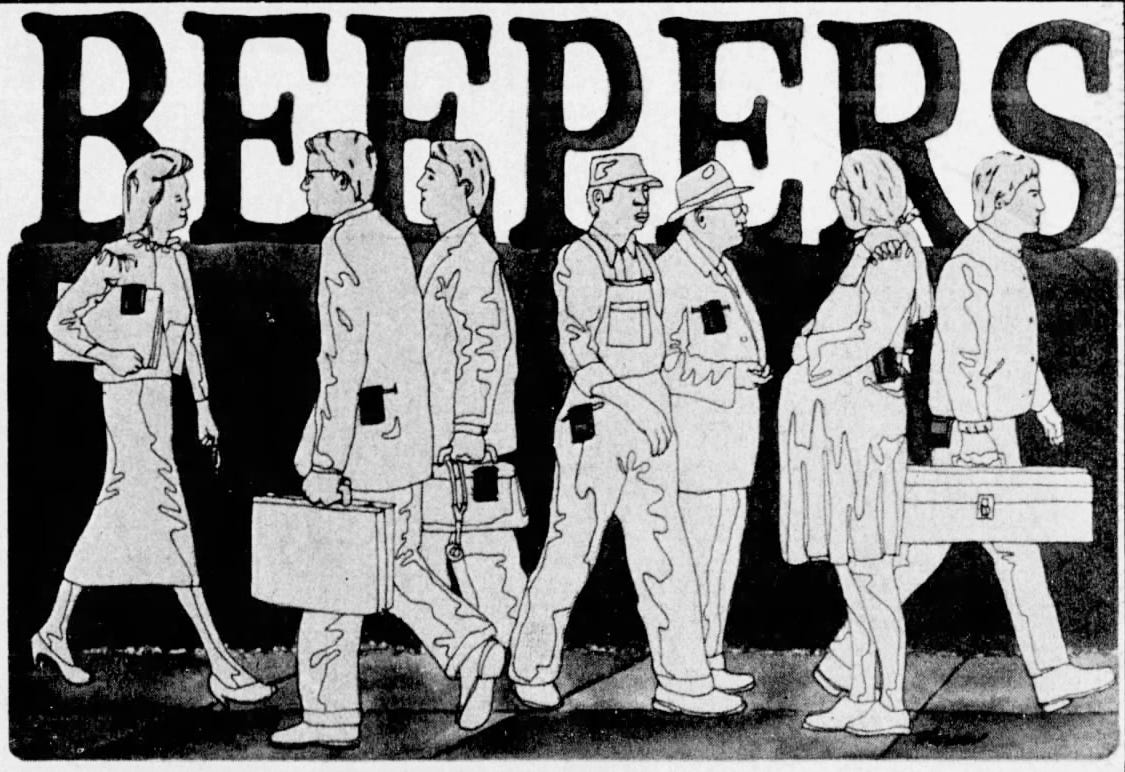
They beep among us
But the most resonant echo of the future, for me, comes from a Florida pager dealer named Larry Gabriel. When the Palm Beach Post asked him if “beepers aren’t another example of the ever-increasing complexity of life,” his reply took the same not-my-problem stance as the later executives of other attention-monopolizing devices and platforms: “You want to remember one thing: They all have an on-off switch.”
So yes, there were people in 1983 who understood the power of mobile connectivity to reshape the way people live. The problem is, some of those clued-in people were the ones cashing in on it. The rest of us just kind of sleepwalked into the age of constantly being on. The technology may have changed, but in human terms, 1983 really wasn’t that long ago.
I never had a beeper—most people I knew who had one were in IT, with the mandatory late night shifts. Even at the time it seemed like such a pain to get a beep and then have to hunt around for a pay phone or business who’d let you borrow their phone for the callback.
How about you, ever have a beeper or other early communication device? When did you get your first cell phone? Let’s hear about it in this week’s Shoddy Goods chat.
—Dave (and the rest of Meh)
Shoddy Goods stories past:
- Electric kettles finally conquer America
- Why sports action figures didn’t go the distance
- A celebration of homemade “Cabbage Patch Kids”
I never had a beeper - most people I knew who had one were in IT, with the mandatory late night shifts. Even at the time it seemed like such a pain to get a beep and then have to hunt around for a pay phone or business who’d let you borrow their phone.
How about you, ever have a beeper or other early communication device? When did you get your first cell phone?
- 17 comments, 2 replies
- Comment
I worked in home care so yes I had a pager. Both Me original ones that only beat you with a number to call back and the ones that where you could actually get text messages on and later the ones that you could text back on. As long as you were texting within the system those were kind of nice I even had one that you could text from a cell phone using special app
I just got my cell phone one week ago.
I did have a pager. We used to send things like 80085 and 07734.
My first cell phone I was about 21 and my parents got it for me after my ex-husband was released from behind bars for the things he did to me.
My parents both had a beeper back in the 80s. They both volunteered for the local ambulance/EMT and would get paged whenever there was an emergency for which they were needed.
January 2002 when the office said I need to have a cell phone on me at all times since I keep getting into these accidents.
Since they weren’t paying for it, I began leaving messages early in the morning alerting them of my (intentional) tardiness.
I got my first beeper in April 1987, when I took my 2nd full-time job in radio news. I had a cellphone when I went out on some assignments, but it was the size of a large attache case and had a giant magnetic antennae with a 30-foot coaxial cable. Eleven years later, I finally got a flip phone, but personal calls were tracked and back-billed to me. When I achieved management status a couple of years later, I finally got the infamous “Crackberry,” which beeped with alerts 24 hours a day. Happy was the day I sold that phone on eBay after getting laid off!
I had a pager circa 1994 until about 1997, mainly because I moved a lot and often didn’t have a landline, so it was the only way people could reliably reach me. Once life settled a bit and was able to have a regular phone number for at least a year at a time—and afford an answering machine, since I was often away from home!—I got rid of it. I got my first cell phone in 2001, and still have the same number nearly 25 years later.
Since I worked in IT, the on-call person always had the beeper overnight or over the weekend. (But I usually just got the call on my home land line.) Then they assigned the on-call person a cell phone and got rid of the beeper.
But, I still got called at home in the middle of the night because I was “responsible” management.
In 1994, I was on the waiting list for a kidney and got a pager in case one became available on short notice. Seemed like a life saver at the time.
I had to carry a beeper in the 80’s & 90’s.
I was a building mechanic for a County Gov’t buildings that included their jail. We did trade off pager duty so I had it every 3 or 4 weeks for 7 days. It was before cell phones so I had to be close to a phone, within 15 minutes they said. I hated it, especially getting calls into the jail at 2 am. Later on, I did get a cell phone so I got rid of the pager & they could just call.
I was a contractor for a pager company in IT support. They offered me a permanent position with a $20k/yr pay cut and I turned it down. Bullet dodged since they were out of business about 2 years later
never had a beeper, but old enough to remember them (graduated H.S. in 1984).
never had a cellphone either.
in 1996, a coworker got one when they were still fairly uncommon.
I tesed him that he was like Gollum with the One Ring . . . "my precious . . "
he said (and I quote) “you don’t understand! now that I have this, anyone can reach me, any time, NO MATTER WHERE I AM!”
and I replied, “and THAT’S why I’ll never have one!”
FWIW, he got rid of his about 3 months later.
he had given the number to numerous co-workers, project offices & clients back in the “olden days” when those phones cost about $1 a minute to use whether you were making calls OR RECEIVING THEM.
as it turned out, our employer would not pay for any of the expense which was adding up to hundreds of dollars a month.
I know he got another, eventually.
my attitude never changed.
frankly, I resent the idea that someone would think they deserve my immediate attention.
now excuse me, while I go back to shouting at clouds.
I worked for NY Tel and then AT&T in sales and had a beeper from the early 80’s on. But we used it only for business. It wasn’t until early cell phones that it became a thing for family and friends to connect remotely! (I still have the non-working pager in some storage bin) .
I worked in hospitals from 1983-1990. They were BIG in hospitals. All the doctors carried them, all administrators, and lots of the staff carried them. Mine was beeping constantly. I even had to carry it nights and weekends. I hated beepers!
There are still pagers around. In classified areas you can’t bring in cellphones or two way pagers. A pager is the solution
I remember when the first noticeable wave of cell phone users came along, their conversations bled into our office landlines as they awaited the light change at the nearby five-way intersection.
Carried a pager for my work with the local VFD then EMS services in the late 80s to mid 90s. Never minded the intrusion since that meant I could be home between runs instead of at the station.
(Not sure how I must this shoddy report earlier…)
@chienfou ahem *mist
@therealjrn
Another voice to text fail…